
Table of Contents
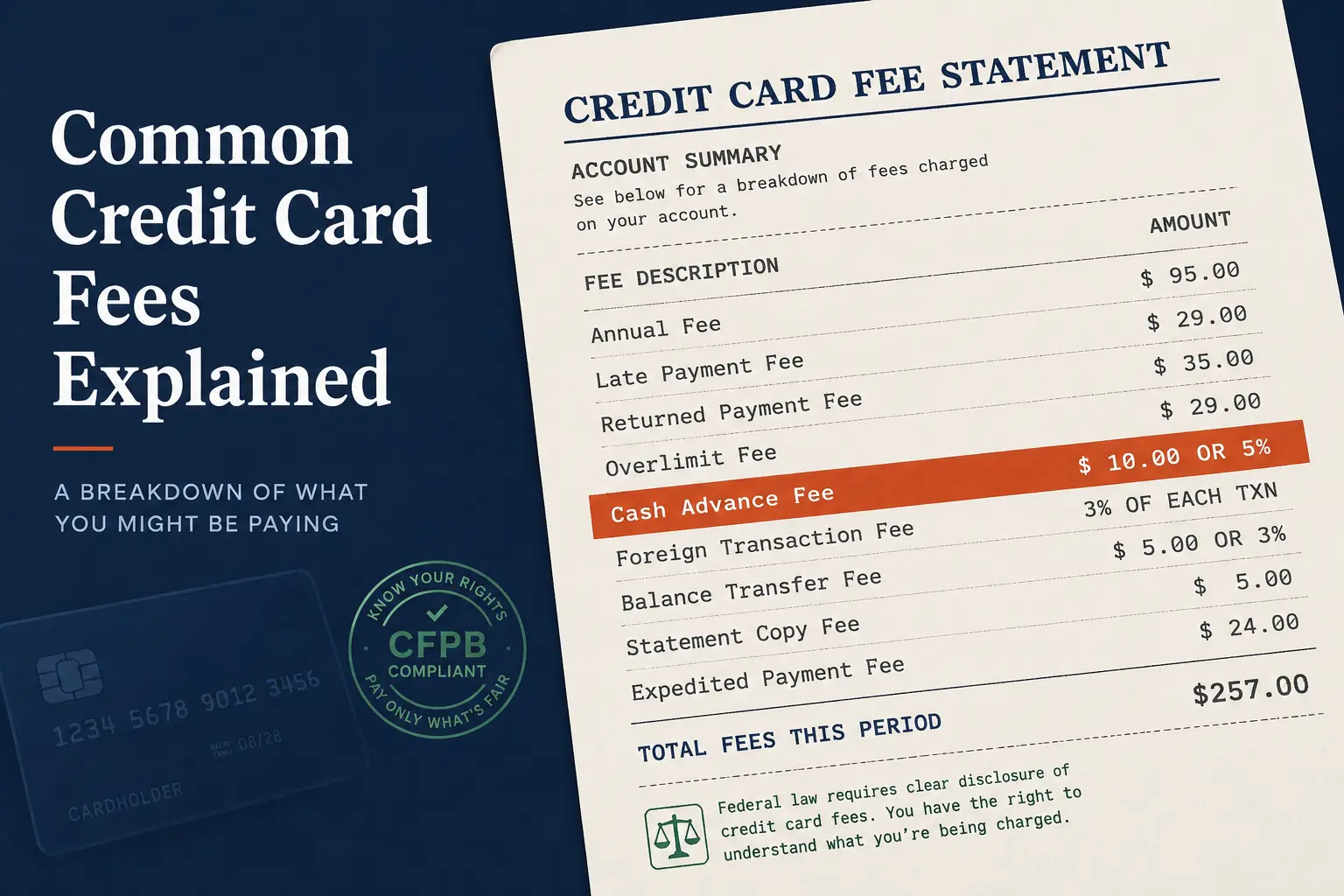
Credit cards can be convenient financial tools, but the pricing structure behind them is often more complicated than the simple “interest rate” most people think of first. Beyond the Annual Percentage Rate (APR), card issuers can apply a range of additional charges — some tied to specific transactions, others triggered by account behavior like a missed payment.
Understanding these fees is not just useful trivia. According to the Consumer Financial Protection Bureau (CFPB), credit card pricing often includes a mix of interest rates, late fees, balance transfer fees, annual fees, cash advance fees, and foreign transaction fees, and the CFPB has noted that this kind of layered pricing complexity can make it harder for consumers to compare products and anticipate true costs.
This article breaks down the most common credit card fees in the U.S. market, explains the regulatory framework that governs them, and outlines how each fee is typically structured. The goal is purely educational — to help readers understand the mechanics of credit card pricing, not to recommend any specific product or course of action.
Why Credit Card Fees Exist
Credit card issuers generate revenue from several sources: interchange fees paid by merchants, interest charged on revolving balances, and various fees charged directly to cardholders. Fees tied to specific account activities — like late payments, cash advances, or foreign purchases — are generally framed by issuers as a way to cover operational costs or discourage certain types of account usage.
The CFPB has studied this fee structure closely, particularly under its broader “junk fees” initiative, which examines charges the agency describes as add little to no value for the consumer while adding to overall costs. Whether a particular fee is considered necessary, avoidable, or excessive often depends on context — and on how the cardholder uses the account.
Annual Fees
An annual fee is a recurring charge — usually billed once per year — simply for holding the card, regardless of how much it’s used. Annual fees are most common on cards that come with rewards programs, travel perks, or premium benefits like airport lounge access.
According to fee surveys conducted by CreditCards.com, only 26 of the 100 cards surveyed in October 2020 charged an annual fee, and the most common fee was $95. The same survey found that seven of those cards didn’t begin charging the annual fee until after the cardholder’s first year.
Annual fees vary widely — from cards with no fee at all to premium travel cards charging several hundred dollars per year. The fee is typically disclosed clearly in the card’s terms before account opening, as required under the Truth in Lending Act (TILA) and its implementing regulation, Regulation Z.
How Annual Fees Are Typically Structured
| Card Type | Typical Annual Fee Range | Common Justification |
|---|---|---|
| No-fee cards | $0 | Basic cards with limited or no rewards |
| Mid-tier rewards cards | $0–$150 | Cashback or points programs |
| Premium travel cards | $250–$700+ | Lounge access, travel credits, elevated rewards |
Late Payment Fees
A late fee is charged when a minimum payment isn’t received by the due date listed on the billing statement. This is one of the most heavily regulated fee categories, and its regulatory history has been unusually active in recent years.
Under Regulation Z, issuers have historically been permitted to charge late fees up to certain “safe harbor” amounts, which were adjusted annually for inflation. As of the most recent published safe harbor levels, the late fee for a first violation could reach $32, with up to $43 for subsequent late payments within six billing cycles for smaller issuers.
In March 2024, the CFPB finalized a rule that would have lowered the late fee safe harbor to a flat $8 for “Larger Card Issuers” — defined as issuers that, together with affiliates, have one million or more open credit card accounts. The CFPB stated this change was expected to reduce the typical late fee from $32 to $8 and estimated an average savings of $220 per year for the more than 45 million people charged late fees.
However, this rule has faced significant legal challenges. On April 15, 2025, a federal district court in Texas vacated the $8 late fee cap rule following a joint motion from the CFPB and the industry groups that had sued to block it. As of 2026, the regulatory status remains in legal flux, with litigation ongoing, though many large issuers that had already lowered their fees to $8 have not reverted to higher amounts.
Key Points About Late Fees
- Late fees apply when a payment isn’t received by the due date stated on the statement
- A payment less than 30 days late typically triggers a fee but is generally not reported to credit bureaus
- Once a payment becomes 30 or more days past due, it may be reported to credit bureaus, which can affect credit scores
- Smaller issuers (fewer than one million open accounts) are not subject to the same fee limitations as larger issuers under the CFPB’s framework
Foreign Transaction Fees
A foreign transaction fee is charged when a purchase is made in a foreign currency or processed through a financial institution located outside the United States — even if the charge appears in U.S. dollars.
Historically, foreign transaction fees were standard across most credit cards. That has changed substantially over the past decade. According to CreditCards.com survey data, foreign transaction fees were charged on 77 out of 100 surveyed cards in 2015, but had fallen to 42 out of 100 cards by 2020, with the most common foreign transaction fee being 3%.
According to information published by Yahoo Finance, the average foreign transaction fee ranges between 1% and 3% per transaction, and many travel-focused credit cards have eliminated this fee entirely to appeal to international travelers.
How the Fee Is Calculated
If a foreign transaction fee is 3% and a cardholder makes a $200 purchase abroad, the fee would add approximately $6 to the transaction, bringing the total charge to $206. This fee is separate from any currency conversion markup that may be applied by the payment network.
Cash Advance Fees
A cash advance allows a cardholder to withdraw cash against their credit line — through an ATM, a bank teller, or in some cases through money transfer apps. This is treated very differently from a standard purchase.
According to Chase, cash advance fees typically range from 3% to 5% of the amount withdrawn, and interest on that amount begins accruing immediately — unlike standard purchases, which often come with a grace period before interest applies.
Discover describes the mechanics this way: if a card issuer charges a 5% fee and the cardholder takes a $100 cash advance, the fee would be $5, meaning $105 total is added to the balance in exchange for $100 in cash.
Capital One notes that the definition of a “cash advance” can extend beyond ATM withdrawals. Transferring money to people or businesses through apps like PayPal or Venmo using a credit card can also be classified as a cash advance by some issuers, triggering the same fees and immediate interest accrual.
Cash Advance Fee Snapshot
| Element | Typical Range |
|---|---|
| Cash advance fee | 3%–5% of amount withdrawn |
| Interest accrual | Begins immediately (no grace period) |
| APR on cash advances | Often higher than standard purchase APR |
Balance Transfer Fees
A balance transfer involves moving debt from one credit card to another, typically to take advantage of a lower introductory interest rate. While the promotional APR can reduce interest costs, most balance transfers come with an upfront fee.
According to Discover, balance transfer fees usually range from 3% to 5% of the total amount transferred, and this cost should be factored in before any transfer is made. CreditCards.com similarly found that the most common balance transfer fee is 3% of the balance.
Some cards offer a $0 balance transfer fee, though Capital One notes a trade-off exists: cards without a balance transfer fee often apply the regular APR to the transferred balance, while cards that charge the fee may offer a lower promotional APR for a limited time.
Returned Payment Fees
A returned payment fee is charged when a scheduled payment fails to process — most often because the linked bank account doesn’t have sufficient funds. Chase describes this as occurring when a card issuer’s charge is rejected due to insufficient funds or an inability to process the transaction.
This fee is separate from a late fee, though both can apply if a returned payment also results in the account becoming past due. Returned payment fees are disclosed in the card’s terms and are generally a fixed dollar amount rather than a percentage.
Over-the-Limit Fees
An over-limit fee applies when a cardholder’s balance exceeds their credit limit. However, this fee category works differently than most others due to opt-in requirements established under the CARD Act of 2009.
Chase explains that card issuers need a cardholder’s consent before charging over-limit transaction fees, and without that opt-in, a transaction exceeding the credit limit will simply be declined rather than approved with a fee. This opt-in requirement means over-limit fees are far less common today than before 2009.
Transaction Fees: A Broader Category
Some issuers use the umbrella term “transaction fee” to cover several of the charges described above. Bank of America defines it broadly: a transaction fee is charged when making balance transfers, direct deposit or check cash advances, or other bank cash advances such as ATM withdrawals, and may also apply to foreign transactions.
This terminology can vary by issuer, which is why reviewing the specific Credit Card Agreement for any given account is the only reliable way to understand exactly which fees apply and under what circumstances.
How Card Issuers Are Required to Disclose Fees
Under TILA and Regulation Z, credit card issuers must disclose fee structures in a standardized format, often called a “Schwumann box” or fee table, included with card applications and account-opening documents. The CFPB’s regulatory commentary specifies detailed rules about how fees — including foreign transaction fees applied to purchases versus cash advances — must be disclosed clearly and conspicuously so that consumers can compare costs across different transaction types.
This disclosure framework is part of why reviewing a card’s terms and conditions, rather than relying solely on marketing materials, provides the most accurate picture of potential fees.
Summary
Credit card fees fall into several broad categories: fees for simply holding the card (annual fees), fees triggered by account behavior (late fees, returned payment fees, over-limit fees), and fees tied to specific transaction types (cash advances, balance transfers, and foreign transactions). Each fee category has its own structure — some are flat dollar amounts, while others are calculated as a percentage of a transaction or balance.
The regulatory landscape around these fees, particularly late fees, has been especially active in recent years. The CFPB’s 2024 rule to cap late fees at $8 for larger issuers was challenged in court and ultimately vacated in 2025, leaving the broader $30–$43 safe harbor framework from Regulation Z in place for many issuers, even as some have voluntarily kept fees lower. Foreign transaction fees, by contrast, have become less common over time as competition among travel-oriented cards has increased.
Because fee structures, regulatory status, and individual card terms can change, the most reliable source of information for any specific account remains the official Credit Card Agreement provided by the issuer.
Frequently Asked Questions
What is the difference between an annual fee and other credit card fees?
An annual fee is a recurring charge tied to simply holding the card, applied regardless of how the card is used. Other fees — like late fees, cash advance fees, or foreign transaction fees — are tied to specific account activity or transactions and only apply when that activity occurs.
Are credit card late fees currently capped at $8?
The CFPB finalized a rule in March 2024 that would have capped late fees at $8 for larger issuers, but this rule was vacated by a federal court in April 2025 following litigation. As of 2026, the regulatory status remains unsettled, and the previous Regulation Z safe harbor amounts (up to $32 for a first late fee and $43 for subsequent late fees) may apply depending on the issuer.
Does a late payment always get reported to credit bureaus?
According to information compiled from issuer and consumer resources, a payment that is less than 30 days late typically results in a fee but is generally not reported to credit bureaus. Reporting usually occurs once a payment becomes 30 or more days past due.
How is a cash advance fee different from a regular purchase fee?
A cash advance fee is typically charged as a percentage (commonly 3% to 5%) of the cash amount withdrawn, and interest on that amount usually begins accruing immediately, without the grace period that often applies to standard purchases.
Can transferring money through apps like PayPal or Venmo trigger a cash advance fee?
According to information published by Capital One, some issuers classify certain money transfers made through peer-to-peer payment apps as cash advances, which can trigger the associated fees and immediate interest accrual. This classification can vary by issuer and card agreement.
What is a foreign transaction fee, and has it become less common?
A foreign transaction fee is charged on purchases made in a foreign currency or processed outside the United States. Survey data shows this fee has become less common over time, dropping from being charged on 77 out of 100 surveyed cards in 2015 to 42 out of 100 by 2020, with 3% being the most commonly reported rate.
What happens if a payment exceeds the credit limit?
Under rules established by the CARD Act of 2009, issuers must obtain a cardholder’s consent before charging over-limit fees. Without that consent, a transaction that would exceed the credit limit is typically declined rather than approved with a fee attached.
Where can someone find the exact fees that apply to a specific credit card?
The Credit Card Agreement provided by the issuer at account opening, and often available through online banking portals, contains the specific fee amounts, structures, and conditions that apply to that particular account. This document is the authoritative source, as marketing materials may not reflect full fee details.
Last Updated: June 13, 2026
Sources
- Consumer Financial Protection Bureau (consumerfinance.gov) — Credit Card Penalty Fees Final Rule and related newsroom statements
- Consumer Financial Protection Bureau — Regulation Z Official Interpretations (Section 1026.60)
- CreditCards.com — Credit Card Fee and Rate Statistics
- Chase, Capital One, Discover, Bank of America — consumer education resources on credit card fees
- Steptoe LLP and Greenberg Traurig LLP — legal analyses of CFPB late fee rulemaking
- Consumer Finance Insights (Goodwin) — litigation updates on CFPB late fee rule
Disclaimer
The content published on CreditPur.com is intended for educational and informational purposes only. Nothing on this page constitutes financial, legal, or credit advice of any kind. Credit card terms, interest rates, fees, and regulatory information can change at any time — readers are encouraged to verify current details directly with card issuers and official sources such as the Consumer Financial Protection Bureau (CFPB) at consumerfinance.gov. CreditPur.com is not a licensed financial advisor and does not recommend or endorse any specific financial product or service.