
Table of Contents
Americans carried $1.252 trillion in credit card debt during the first quarter of 2026, according to Federal Reserve Bank of New York data, while the average annual percentage rate on accounts assessed interest stood at 21.52%, per the Federal Reserve’s G.19 Consumer Credit release. Within that environment, cash back credit cards remain one of the most widely used tools for offsetting everyday spending. Comparing the best cash back credit cards for June 2026 requires looking past advertised headline rates to the full structure of fees, spending caps, and APRs behind each offer.
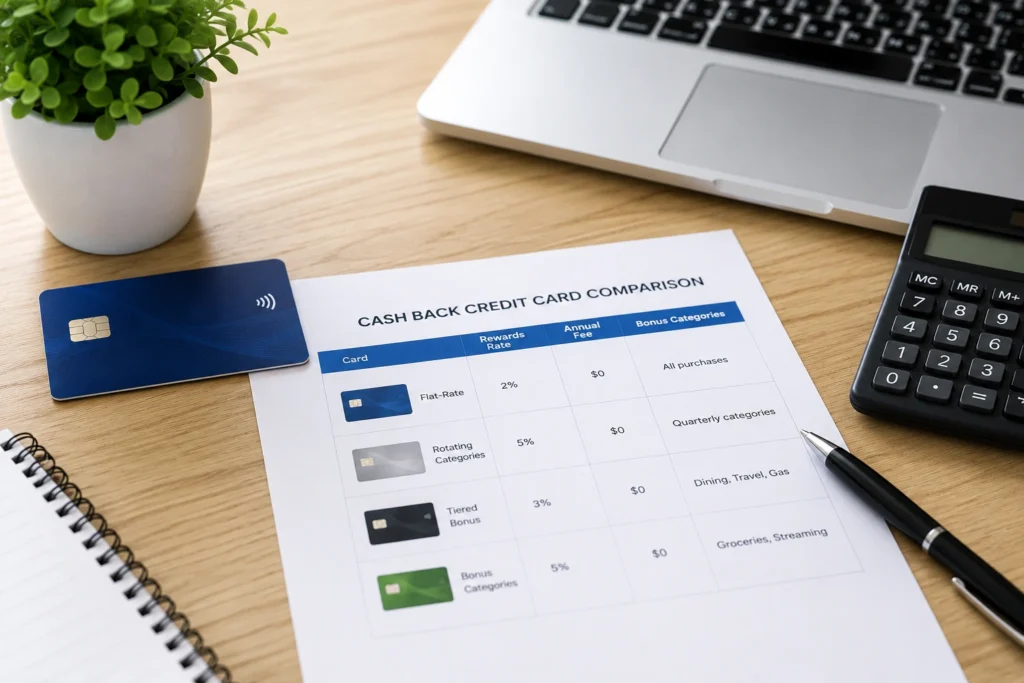
The cash back credit card market in June 2026 spans three broad structures: flat-rate cards that pay the same percentage on every purchase, rotating-category cards that pay an elevated rate on categories that change quarterly, and tiered bonus-category cards that pay a fixed elevated rate on specific spending types such as groceries or gas. This article documents the published rewards rates, annual fees, introductory APR offers, and ongoing APRs of eight widely available cash back credit cards. It also reviews the federal regulatory framework governing how credit card terms are disclosed and how billing disputes are resolved.
How Cash Back Credit Cards Are Structured
Cash back credit cards convert a portion of each purchase into a reward, typically expressed as a percentage of the transaction amount. The Consumer Financial Protection Bureau’s biennial market report describes rewards programs as one of several features issuers use to differentiate cards, alongside annual percentage rates, fees, and credit limits. Three structural categories account for most cash back products currently marketed in the United States, and understanding how a credit card works within each structure clarifies how the advertised rate translates into an actual reward.
Flat-rate cards pay an identical cash back percentage on nearly all purchases, regardless of merchant category, with no enrollment step required. Rotating-category cards pay a higher percentage — frequently 5% — on a defined list of merchant categories that changes every three months, with a lower base rate applying to all other spending. Tiered or bonus-category cards pay a fixed, elevated percentage on specific, unchanging categories such as supermarkets, gas stations, or streaming subscriptions, with a lower base rate on remaining purchases. Each of these credit card types carries trade-offs in complexity, annual or quarterly spending caps, and the degree of category tracking required to capture the advertised rate.
Flat-Rate Cash Back Cards for June 2026
Flat-rate cards apply a single cash back percentage across nearly all purchase categories, with no activation step required. Four widely available flat-rate cards carry a $0 annual fee as of June 2026.
Citi Double Cash® Card
The Citi Double Cash® Card earns 2% cash back on most purchases, structured as 1% at the time of purchase and an additional 1% when that purchase is paid off. The card carries a $0 annual fee and a 3% foreign transaction fee. Rewards accrue as Citi ThankYou® Points, which can be redeemed for cash back, gift cards, or transferred to ThankYou® travel partners.
New cardholders can access a 0% introductory APR for 18 months on balance transfers completed within four months of account opening, after which a variable APR of 17.49%–27.49% applies; this introductory offer does not extend to new purchases. A current welcome offer provides $200 cash back after $1,500 in purchases within six months, delivered as 20,000 ThankYou® Points.
Wells Fargo Active Cash® Card
The Wells Fargo Active Cash® Card earns an unlimited 2% cash rewards rate on purchases, with no bonus categories to track. The card has a $0 annual fee and a 3% foreign transaction fee. It includes cell phone protection of up to $600 per claim when the monthly cell phone bill is paid with the card.
A 0% introductory APR applies for 12 months from account opening on both purchases and qualifying balance transfers. After that period, the ongoing APR is tiered at 18.49%, 24.49%, or 28.49% variable, based on creditworthiness. The current welcome offer is $200 in cash rewards after $500 in purchases within the first three months.
Capital One Quicksilver Cash Rewards Credit Card
The Capital One Quicksilver Cash Rewards Credit Card earns an unlimited 1.5% cash back rate on every purchase, along with 5% cash back on hotels, vacation rentals, and rental cars booked through Capital One Travel. The card carries a $0 annual fee and charges no foreign transaction fee, one of two cards in this comparison with that feature.
A 0% introductory APR applies for 15 months on purchases and balance transfers, followed by a variable APR of 18.49%–28.49%. The welcome offer is a one-time $200 cash bonus after $500 in purchases within three months of account opening. Balance transfers carry a 3% fee for the first 15 months, rising to 4% afterward.
Chase Freedom Unlimited®
The Chase Freedom Unlimited® card earns 5% cash back on travel purchased through Chase Travel℠, 3% on dining (including takeout and eligible delivery) and drugstore purchases, and 1.5% on all other purchases. This tiered structure gives it the highest minimum rate among the flat-rate cards examined here, though its bonus categories place it closer to a tiered card in practice. The card has a $0 annual fee and a 3% foreign transaction fee.
A 0% introductory APR applies for 15 months on purchases and balance transfers, after which a variable APR of 18.24%–27.74% applies. The current welcome offer is $200 after $500 in purchases within the first three months. Rewards accrue as Chase Ultimate Rewards® points, redeemable for cash back at one cent per point.
Rotating-Category Cash Back Cards for June 2026
Rotating-category cards pay an elevated cash back rate — typically 5% — on a defined set of merchant categories that changes each quarter or billing cycle. These cards are generally subject to a spending cap and an activation requirement before the elevated rate applies.
Discover it® Cash Back
The Discover it® Cash Back card earns 5% cash back on rotating quarterly categories, up to $1,500 in combined purchases per quarter after activation, with 1% cash back on all other purchases. Published 2026 categories include grocery stores, wholesale clubs, and select streaming services for the first quarter; restaurants and home improvement stores for the second quarter; and gas stations, EV charging, public transportation, flights, and drugstore purchases for the third quarter.
The card has a $0 annual fee and charges no foreign transaction fee. A 0% introductory APR applies for 15 months on purchases and balance transfers, after which a variable APR of 17.49%–26.49% applies. In place of a traditional welcome bonus, Discover matches all cash back earned during the cardholder’s first 12 billing periods, with no spending cap on the match.
Citi Custom Cash® Card
The Citi Custom Cash® Card earns 5% cash back on the cardholder’s top eligible spending category each billing cycle, up to the first $500 spent in that category, then 1% for the remainder of the cycle; all other purchases earn an unlimited 1%. Eligible categories include restaurants, gas stations, grocery stores, drugstores, home improvement stores, transit, and select streaming services, with the qualifying category determined automatically rather than through manual selection.
The card also earns 4% cash back on hotels, car rentals, and attractions booked through Citi Travel℠ through June 30, 2026. It carries a $0 annual fee and a 3% foreign transaction fee. A 0% introductory APR applies for 15 months on purchases and balance transfers, after which a variable APR of 18.24%–28.24% applies, and the welcome offer is $200 cash back after $1,500 in purchases within six months.
Tiered Bonus-Category Cash Back Cards for June 2026
Tiered bonus-category cards apply a fixed, elevated cash back rate to specific, unchanging spending categories rather than rotating ones, generally subject to an annual spending cap per category.
Blue Cash Everyday® Card from American Express
The Blue Cash Everyday® Card from American Express earns 3% cash back at U.S. supermarkets, 3% at U.S. gas stations, and 3% on U.S. online retail purchases, each up to $6,000 in annual spending per category before reverting to 1%; all other purchases earn 1%. The card has a $0 annual fee and a 2.7% foreign transaction fee.
A 0% introductory APR applies for 15 months on purchases and balance transfers, after which a variable APR of 19.49%–28.49% applies. The current welcome offer provides up to $200 cash back after $2,000 in purchases within six months. Rewards accrue as Reward Dollars, redeemable as a statement credit or at Amazon.com checkout.
Blue Cash Preferred® Card from American Express
The Blue Cash Preferred® Card from American Express earns 6% cash back at U.S. supermarkets on up to $6,000 in annual spending (then 1%), 6% on select U.S. streaming subscriptions, 3% at U.S. gas stations and on transit purchases, and 1% on all other purchases. The card has a $0 introductory annual fee for the first year, then $95 annually, along with a 2.7% foreign transaction fee.
A 0% introductory APR applies for 12 months on purchases and balance transfers, after which a variable APR of 19.49%–28.49% applies. The current welcome offer provides up to $300 cash back after $3,000 in purchases within six months. A separate statement credit of up to $10 monthly is available for eligible Disney+, Hulu, or ESPN+ subscription charges.
Best Cash Back Credit Cards for June 2026: Side-by-Side Comparison
| Card | Rewards Structure | Highest Published Rate | Annual Fee | Introductory APR | Ongoing Variable APR | Foreign Transaction Fee |
|---|---|---|---|---|---|---|
| Citi Double Cash® Card | Flat-rate | 2% on all purchases | $0 | 0% / 18 mo. (balance transfers only) | 17.49%–27.49% | 3% |
| Wells Fargo Active Cash® Card | Flat-rate | 2% on all purchases | $0 | 0% / 12 mo. (purchases & BT) | 18.49% / 24.49% / 28.49% | 3% |
| Capital One Quicksilver | Flat-rate | 1.5% (5% on Capital One Travel) | $0 | 0% / 15 mo. (purchases & BT) | 18.49%–28.49% | None |
| Chase Freedom Unlimited® | Flat-rate + bonus tiers | 5% Chase Travel; 3% dining/drugstores | $0 | 0% / 15 mo. (purchases & BT) | 18.24%–27.74% | 3% |
| Discover it® Cash Back | Rotating category | 5% rotating (cap $1,500/quarter) | $0 | 0% / 15 mo. (purchases & BT) | 17.49%–26.49% | None |
| Citi Custom Cash® Card | Auto-adjusting category | 5% top category (cap $500/cycle) | $0 | 0% / 15 mo. (purchases & BT) | 18.24%–28.24% | 3% |
| Blue Cash Everyday® (Amex) | Tiered bonus | 3% supermarkets/gas/online (cap $6,000/yr each) | $0 | 0% / 15 mo. (purchases & BT) | 19.49%–28.49% | 2.7% |
| Blue Cash Preferred® (Amex) | Tiered bonus | 6% supermarkets (cap $6,000/yr); 6% streaming | $0 intro yr. 1, then $95 | 0% / 12 mo. (purchases & BT) | 19.49%–28.49% | 2.7% |
Rates, fees, and APR ranges reflect terms published by each issuer as of June 2026 and are subject to change. Current terms should be verified directly on the issuer’s official website before applying.
Key Terms / Glossary
- Annual Percentage Rate (APR): The yearly interest rate charged on unpaid balances, expressed as a percentage; credit cards typically list both an introductory APR and an ongoing variable APR.
- Introductory APR: A temporary, often 0%, interest rate offered for a defined period after account opening, applicable to purchases, balance transfers, or both, depending on the card.
- Flat-rate cash back: A rewards structure that pays the same cash back percentage on virtually all purchases, regardless of merchant category.
- Rotating bonus category: A merchant category designated by the issuer for an elevated cash back rate during a specific quarter, generally requiring activation and subject to a spending cap.
- Tiered bonus category: A fixed, unchanging merchant category — such as supermarkets or gas stations — that earns an elevated, capped cash back rate year-round.
- Foreign transaction fee: A surcharge, commonly 2%–3% of the transaction amount, applied to purchases processed outside the United States or through a foreign merchant.
- Balance transfer fee: A one-time charge, typically 3%–5% of the transferred amount, assessed when moving a balance from one credit account to another.
- Variable APR: An interest rate tied to an external benchmark, such as the prime rate, that can change over the life of the account as that benchmark moves.
Regulatory and Legal Context
Federal disclosure requirements for credit card terms originate primarily from the Truth in Lending Act, implemented through the Federal Reserve’s Regulation Z, which mandates standardized disclosure of APRs, fees, and grace periods in a card’s terms and conditions. The Credit Card Accountability Responsibility and Disclosure Act of 2009 (CARD Act) added further restrictions on rate increases, payment allocation, and marketing to applicants under 21. The Act also directs the Consumer Financial Protection Bureau to publish a biennial review of the credit card market; the CFPB’s most recent report, covering data through the end of 2024, was released in December 2025.
Billing disputes on credit card accounts, including cash back cards, are governed by the Fair Credit Billing Act, enforced by the Federal Trade Commission. Under the Act, a cardholder may dispute a billing error in writing within 60 days of the statement on which it first appeared. The issuer must acknowledge the dispute within 30 days and resolve it within two billing cycles, not to exceed 90 days, and the disputed amount cannot be subject to collection action during that investigation.
The same federal framework caps a cardholder’s liability for unauthorized charges at $50, a protection most major issuers extend further through zero-liability policies. The CFPB separately maintains a public database of credit card agreements and conducts a semiannual Terms of Credit Card Plans survey across more than 150 issuers, both of which can be used to verify a card’s current published terms.
Summary
Cash back credit cards available in June 2026 generally fall into three structures: flat-rate cards such as the Citi Double Cash® Card and Wells Fargo Active Cash® Card that pay a consistent 2% across most spending; rotating-category cards such as the Discover it® Cash Back and Citi Custom Cash® Card that pay 5% on categories that change periodically; and tiered bonus-category cards such as the Blue Cash Everyday® and Blue Cash Preferred® Cards from American Express that pay a fixed elevated rate on specific spending types like groceries or streaming subscriptions.
All eight cards examined carry a $0 annual fee except the Blue Cash Preferred® Card, which waives its $95 fee for the first year only. Ongoing variable APRs across the group range from approximately 17.49% to 28.49%, broadly consistent with national averages reported by the Federal Reserve for the first quarter of 2026. Foreign transaction fees, where present, range from 2.7% to 3%, while the Capital One Quicksilver and Discover it® Cash Back cards charge none.
Frequently Asked Questions
What is a cash back credit card?
A cash back credit card returns a percentage of each purchase to the cardholder as a reward, typically credited as a statement credit, direct deposit, or check. The percentage returned depends on the card’s structure — flat-rate, rotating-category, or tiered bonus-category — and may range from 1% to 6% depending on the purchase type. Cash back differs from points or miles programs in that the reward value is fixed and does not depend on how it is redeemed. Most cash back cards allow redemption at any dollar amount, though some issuers set minimum redemption thresholds for certain redemption types such as paper checks.
How is cash back different from points or miles?
Cash back rewards are denominated directly in dollars and cents, so a given cash back balance generally redeems for a fixed cash value regardless of how it is used. Points and miles programs, by contrast, often have variable redemption values that change depending on whether they are used for cash back, travel bookings, gift cards, or merchandise, with travel redemptions frequently returning more value per point than a cash back redemption of the same balance. Some cards examined in this comparison technically earn points, such as Chase Ultimate Rewards® or Citi ThankYou® Points, that are automatically valued at one cent each when redeemed for cash back while offering different values for other redemption types.
What is the difference between flat-rate, rotating-category, and tiered bonus-category cash back cards?
Flat-rate cards pay one cash back percentage on nearly all purchases with no category tracking required. Rotating-category cards pay an elevated rate, often 5%, on merchant categories the issuer changes every quarter, usually requiring activation and subject to a spending cap before the rate reverts to a lower base rate. Tiered bonus-category cards pay a fixed, elevated rate on specific categories that do not change, such as groceries or gas stations, also typically subject to an annual spending cap. Each structure involves a different level of ongoing attention from the cardholder to capture the advertised rate consistently.
Do cash back rewards expire?
Expiration policies vary by issuer and are disclosed in each card’s terms and conditions. Several cards examined in this comparison, including the Citi Double Cash® Card, Wells Fargo Active Cash® Card, and Discover it® Cash Back, state that cash back rewards do not expire as long as the account remains open and in good standing. Rewards are generally forfeited if an account is closed, particularly if it is closed for non-payment, and some issuers require at least the minimum payment to be made on time each billing cycle for that cycle’s rewards to be credited. Cardholders can confirm current expiration terms in the rewards section of their card’s official terms and conditions.
Is credit card cash back considered taxable income?
The Internal Revenue Service has generally treated credit card cash back earned through ordinary spending as a rebate or discount on the purchase price rather than as taxable income, since the cardholder must spend money to receive the reward. This treatment is distinct from cash bonuses or rewards received without a spending requirement, such as some bank account opening bonuses, which the IRS has treated as taxable income in past guidance. Tax treatment of specific rewards programs can vary by circumstance, and this information is general in nature rather than tax advice for any individual situation.
What credit score is typically associated with approval for a no-annual-fee cash back card?
Issuer marketing materials for the cards examined in this comparison generally describe a target range of good to excellent credit, though specific score thresholds are not published by issuers and approval depends on multiple factors beyond credit score, including income, existing debt, and overall credit history. The Consumer Financial Protection Bureau’s credit card market data shows that approval rates and offered APRs vary meaningfully across credit score tiers, with the spread between the lowest and highest advertised APR on a single card often exceeding 10 percentage points. Each issuer’s official application page outlines the general credit profile associated with a given card.
Can a cash back card have both an annual fee and a 0% introductory APR offer?
Yes. Annual fees and introductory APR offers are independent features of a credit card’s terms. Among the cards examined here, the Blue Cash Preferred® Card from American Express carries a $0 introductory annual fee for the first year, then $95 annually, while also offering a 0% introductory APR for 12 months on purchases and balance transfers. The presence of an annual fee does not affect eligibility for an introductory APR offer, and both terms are disclosed separately in a card’s rates and fees table required under the Truth in Lending Act.
What happens to unused cash back if a credit card account is closed?
Treatment of unredeemed rewards upon account closure is governed by each issuer’s terms and conditions rather than a uniform federal rule. Several issuers state that rewards are forfeited if an account is closed, particularly when closure results from delinquency or a violation of the cardholder agreement, while accounts closed in good standing may allow a final redemption window in some cases. Cardholders can review the rewards forfeiture section of their specific card agreement, also available through the CFPB’s public credit card agreement database, for the exact terms that apply to their account.
Sources
- Consumer Financial Protection Bureau. “The Consumer Credit Card Market” (2025 Report). https://www.consumerfinance.gov/data-research/research-reports/the-consumer-credit-card-market-2025/
- Federal Register. “Consumer Credit Card Market Report of the Consumer Financial Protection Bureau, 2025.” https://www.federalregister.gov/documents/2026/01/07/2026-00081/consumer-credit-card-market-report-of-the-consumer-financial-protection-bureau-2025
- Consumer Financial Protection Bureau. Explore Credit Cards Tool — Wells Fargo Active Cash® Card. https://www.consumerfinance.gov/consumer-tools/credit-cards/explore-cards/cards/wells-fargo-bank-national-association-wells-fargo-active-cash-card/
- Board of Governors of the Federal Reserve System. G.19 Consumer Credit Release. https://www.federalreserve.gov/releases/g19/current/
- Federal Trade Commission. “Using Credit Cards and Disputing Charges.” https://consumer.ftc.gov/articles/using-credit-cards-and-disputing-charges
- Federal Trade Commission. “Fair Credit Billing Act.” https://www.ftc.gov/legal-library/browse/statutes/fair-credit-billing-act
- Chase. Chase Freedom Unlimited® Official Product Page. https://creditcards.chase.com/cash-back-credit-cards/freedom/unlimited
- Citi. Citi Double Cash® Card Official Product Page. https://www.citi.com/credit-cards/citi-double-cash-credit-card
- Discover. Discover it® Cash Back Official Product Page. https://www.discover.com/credit-cards/cash-back/it-card/
- Capital One. Quicksilver Cash Back Rewards Card Official Product Page. https://www.capitalone.com/credit-cards/quicksilver/
- American Express. Blue Cash Preferred® Card Official Product Page. https://www.americanexpress.com/us/credit-cards/card/blue-cash-preferred/
- American Express. Blue Cash Everyday® Card Official Product Page. https://www.americanexpress.com/us/credit-cards/card/blue-cash-everyday/
Disclaimer
This article is for general educational and informational purposes only and does not constitute financial, legal, or tax advice. Credit card rates, fees, rewards terms, and introductory offers are determined solely by each card issuer, change frequently, and may vary based on individual creditworthiness. Figures presented reflect terms published by issuers and reviewed as of June 2026 and should be independently verified on the issuer’s official website before applying for any card. This content does not constitute an endorsement of any specific financial product, and CreditPur.com is not a lender, card issuer, or registered financial advisor.