
Table of Contents
Introduction: Why Understanding Credit Card Types Actually Matters
Most people know what a credit card is. You swipe it, you buy something, you get a bill. Simple enough. But here’s where things get more interesting — and where a lot of people run into trouble.
Not all credit cards work the same way. A secured credit card and a travel rewards card might look identical sitting in your wallet, but they operate on completely different logic. A charge card looks like a credit card but isn’t one in the traditional sense. A store card carries risks that a general-purpose rewards card doesn’t. These are not small distinctions.
According to the Federal Reserve, 81% of U.S. adults had at least one credit card in 2024 — that’s more than 216 million Americans using credit as part of their regular financial toolkit. Yet the variety within the credit card market is something many cardholders never fully explore. Most people end up with whatever card they were approved for first, or whatever showed up in a mailer, without a real understanding of the landscape.
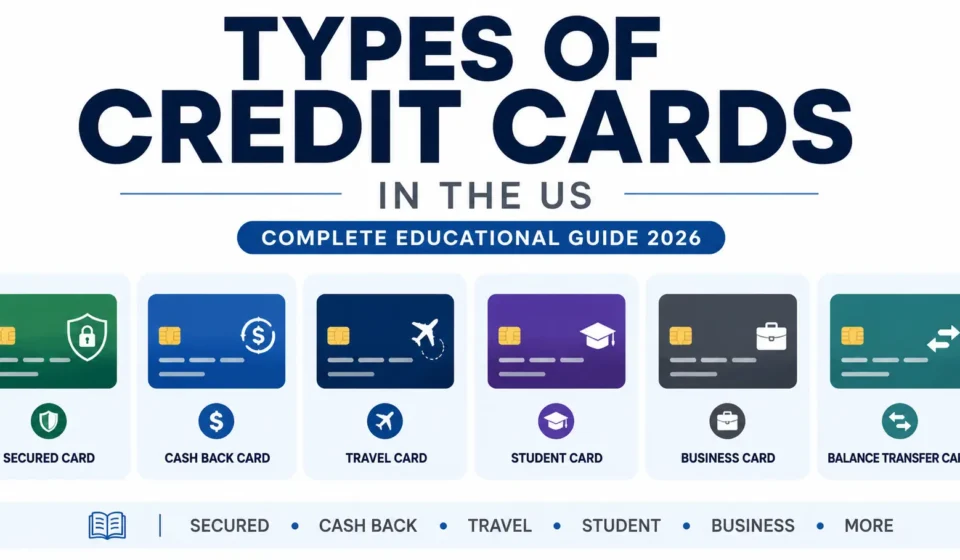
This article breaks down every major type of credit card available in the US market — how each one works, what features define it, how it differs from similar products, and what role it typically plays in someone’s financial life. The goal is purely educational: to give you a clear, accurate picture of what exists and why.
A Quick Foundation: What a Credit Card Actually Is
Before diving into types, it’s worth being precise about what makes something a credit card in the first place — because that boundary matters when comparing products.
Prepaid cards and debit cards are ways to spend money you already have. Credit cards are ways to borrow money. That’s how the Consumer Financial Protection Bureau (CFPB), the US federal agency responsible for consumer financial protection, puts it.
When you use a credit card, you’re drawing on a line of credit extended to you by an issuer — a bank or financial institution. You’re not spending your own funds. You owe that money back, and if you don’t pay it in full, interest accrues. That revolving debt structure is the core of what makes a credit card a credit card.
Everything else — rewards, fees, deposit requirements, spending limits — sits on top of that foundation.
The US Credit Card Landscape: A Quick Snapshot
Americans’ total credit card balance stood at $1.252 trillion as of Q1 2026, according to the Federal Reserve Bank of New York — down slightly from the record high of $1.277 trillion set in Q4 2025.
The average credit card APR on interest-bearing accounts was 22.3% as of Q4 2025, with rates having risen sharply after 2021 as the Federal Reserve hiked its benchmark interest rate, though moderating somewhat in 2025 and 2026.
These numbers matter as context. Credit cards are powerful financial tools. Understanding the type of card you hold — and the terms that come with it — directly affects the cost of using it.
Part 1: Cards Defined by How They’re Structured
Standard Unsecured Credit Cards
This is the baseline. An unsecured credit card doesn’t require any deposit or collateral. Approval is based entirely on the applicant’s credit profile — credit history, score, income, and existing debts. The issuer is essentially deciding whether to trust you with borrowed money based on your track record.
The term “unsecured” is easy to misread. It doesn’t mean the card is unsafe or unprotected — it means it’s not secured by a deposit. The issuer takes on the default risk themselves.
Standard unsecured cards span an enormous range. Some are basic cards with no rewards and modest limits for people with average credit. Others are premium products with hundreds of dollars in annual fees and a suite of travel benefits targeting consumers with excellent credit profiles. The category is more of a structural description than a quality indicator.
Key features at a glance:
- No deposit required
- Credit limit set by the issuer based on creditworthiness
- Revolving balance: you can carry debt month to month, with interest
- Available with or without rewards programs
- Annual fees range from $0 to $695+ depending on the card tier
Secured Credit Cards
A secured credit card flips the risk equation. Instead of the issuer extending credit based purely on trust, the applicant provides a cash deposit upfront. That deposit backs the cardholder’s credit limit — and unlike the money loaded onto a prepaid card, it isn’t used to pay for purchases. It’s held as collateral and may be refunded when the cardholder eventually qualifies for a traditional card.
In practical terms: if you deposit $300, you typically get a $300 credit limit. You spend on the card, get billed monthly, and pay like any other credit card. The deposit just sits there — it’s not touched unless you default.
According to a LendingTree analysis of 47 secured credit cards, the minimum deposit required is most commonly $200. Average APRs on secured cards run around 23.40%, though many secured cards carry APRs of 28% or higher — with some reaching 29.99%.
Why does a card backed by your own money still charge interest? Because the deposit compensates the bank for the higher risk of default — and paying interest would reduce that compensation, potentially making the product financially unviable for the issuer.
Who typically uses secured cards? People new to credit, those rebuilding after financial setbacks, and anyone who can’t qualify for an unsecured card. Most financial institutions report secured card activity to the major credit bureaus — Experian, Equifax, and TransUnion — and it’s that reporting that allows cardholders to build a strong credit history over time.
One important upgrade path worth knowing: some issuers offer to convert a secured card into an unsecured card once the cardholder has made on-time payments for six to 12 months. Others require the cardholder to request the upgrade. Once approved for an unsecured card from the same issuer, the secured card is closed and the security deposit is refunded.
Charge Cards
A charge card looks almost identical to a standard credit card. Same plastic, same network logo, same swipe-and-sign experience. The difference lives in how the balance is handled — and it’s a significant one.
The defining difference between credit cards and charge cards lies in the ability to carry a balance. Traditional charge cards don’t allow that. You must pay the balance in full every month. Credit cards let you pay for purchases over time, usually with interest.
Because you can’t carry a balance on a traditional charge card, there’s no APR to quote. No interest accumulates — as long as you pay in full by the due date. Many charge cards also don’t come with a fixed credit limit in the traditional sense; spending power adjusts based on the cardholder’s history and financial profile.
American Express has historically been the last major issuer of charge cards in the US, but even those cards now allow payment for certain purchases over time — which somewhat blurs the traditional distinction.
Charge cards tend to carry higher annual fees and come with premium perks — travel credits, airport lounge access, concierge services. The higher fee is justified, in part, by the absence of interest revenue from carried balances.
One interesting nuance for credit scoring: because charge cards don’t carry revolving balances month to month, they interact differently with credit utilization calculations compared to standard revolving credit cards. Some credit scoring models treat them separately.
Part 2: Cards Defined by What They Reward
Cash Back Credit Cards
Cash back cards do exactly what the name suggests — they return a percentage of your spending as cash. It’s the most direct and straightforward reward structure in the market.
The mechanics are simple: you make a purchase, and the card gives you back a percentage of what you spent. For example, spending $100 on groceries with a card that offers 2% cash back returns $2 to you.
That cash can typically be redeemed as a statement credit reducing your balance, a direct deposit into a linked bank account, or sometimes a check. There are no points currencies to track, no redemption portals to navigate.
Cash back cards generally fall into one of three structures:
Flat-rate cards pay the same percentage on every purchase, regardless of category. These are the simplest option — spend anywhere, earn consistently.
Category-based cards pay a higher rate in specific spending areas (often groceries, dining, gas, or travel) and a lower base rate on everything else. These reward cardholders who concentrate spending in particular areas.
Rotating category cards offer elevated rates — sometimes as high as 5% — in categories that change every quarter. The cardholder usually needs to activate the categories each quarter to earn the bonus rate. This requires more attention but can deliver higher returns for engaged cardholders.
In 2023, roughly 55% of credit card reward redemptions in the US were for cash back, making it the most popular rewards redemption type — well ahead of travel at 25%.
Travel Rewards Credit Cards
Travel cards earn points or miles instead of cash. Those points can be redeemed for flights, hotel stays, car rentals, and other travel expenses — though the value of each point varies considerably depending on how it’s used.
General-purpose travel cards offer flexibility because you’re not locked into redeeming with a specific airline or hotel brand. You can use points to book travel through the issuer’s portal or redeem them as a credit against travel purchases already made.
Co-branded travel cards, on the other hand, are tied to a specific airline or hotel chain. They earn the brand’s own currency — airline miles or hotel points — and typically offer elevated earning when spending directly with that brand. The tradeoff is reduced flexibility.
The transfer partners available through a card’s rewards program matter significantly. Chase Ultimate Rewards, Capital One Miles, Citi ThankYou Rewards, and Amex Membership Rewards each have different transfer partners — and for travelers who want to maximize point value, those transfer relationships should be a major factor in card selection.
Travel rewards cards almost always offer higher welcome bonuses than cash back cards. The first few months of card ownership can be particularly valuable, as these bonuses can sometimes be worth hundreds or even thousands of dollars in travel.
Travel cards frequently waive foreign transaction fees, include travel insurance benefits, and may offer perks like Global Entry or TSA PreCheck application credits, airport lounge access, and trip cancellation protection. Premium travel cards carry annual fees that can reach several hundred dollars — the value calculation depends heavily on how much of those benefits the cardholder actually uses.
Store and Retail Credit Cards
Store cards (also called retail cards) are tied to a specific merchant or retail chain. They come in two distinct forms, and that distinction matters:
Closed-loop store cards can only be used at the issuing retailer or its affiliated brands. They can’t be swiped at the grocery store or a gas station. They tend to have lower credit limits and are often easier to qualify for than general-purpose cards.
Open-loop co-branded retail cards carry a Visa, Mastercard, or other network logo. They work anywhere that network is accepted but offer elevated rewards when spending at the affiliated retailer.
The most consistent warning about store cards is their interest rates. Retail cards historically carry some of the highest APRs in the credit card market — often higher than comparable general-purpose cards. For cardholders who carry a balance, that can be financially significant.
Store cards do sometimes offer genuine value in the form of retailer-specific discounts, deferred interest promotions on large purchases, or early access to sales. Deferred interest promotions in particular deserve attention: these are different from 0% APR offers. With deferred interest, if the balance isn’t paid in full by the end of the promotional period, all the interest that accumulated during that period can be applied retroactively. The CFPB has specifically flagged deferred interest products as a source of consumer confusion and cost.
Part 3: Cards Defined by Who They’re Designed For
Student Credit Cards
Student credit cards are built for college students who are entering the credit system for the first time. The eligibility criteria are generally more accessible than standard cards — issuers recognize that most students have limited credit history, modest income, or both.
The CARD Act, passed in 2009, introduced specific protections relevant to younger applicants: it prohibits issuers from issuing credit cards to individuals under 21 without obtaining an application that either includes the signature of an individual over 21 who has the means to repay and agrees to joint liability, or demonstrates that the applicant under 21 has an independent ability to repay.
In plain terms: most people under 21 need either a cosigner or independent income to get a credit card. Student cards are typically unsecured and carry modest limits, though secured student card options also exist for applicants without any credit history at all.
Some student cards include features specifically oriented toward early credit education: access to free credit score monitoring, small statement credits tied to academic performance, or automatic credit limit reviews after several months of responsible use.
The primary function of a student card isn’t to earn rewards — it’s to start a credit history under responsible conditions.
Business Credit Cards
Business credit cards are issued to businesses rather than individuals for personal use. The “business” can range from a corporation with thousands of employees to a freelancer or sole proprietor.
These cards are structured around business spending patterns, with elevated earning rates in categories like advertising, office supplies, travel, shipping, and telecommunications. They often come with tools for managing employee spending — the ability to issue employee cards, set individual spending limits, and generate detailed expense reports.
One important consumer protection distinction: the CARD Act amended the Truth in Lending Act to prescribe open-end credit lending procedures and enhanced disclosures to consumers, limit related fees and charges, and establish constraints for issuance of credit cards to students and minors. However, many of these protections apply specifically to consumer credit cards — not business cards. Business cardholders and sole proprietors should review issuer terms carefully, as certain CARD Act protections may not extend to business accounts.
Many business credit cards also require a personal guarantee, meaning the business owner is personally liable for the debt if the business cannot repay it.
Part 4: Cards Defined by Their Debt Management Purpose
Balance Transfer Credit Cards
Balance transfer cards occupy a different niche than the cards above. Their primary function isn’t earning rewards or building credit — it’s managing existing debt.
A balance transfer allows you to move credit card debt from one card to another with a lower interest rate, sometimes one with a 0% introductory APR. The benefit is greatest if you can pay off the transferred balance within the promotional period. Most cards charge a transfer fee of 3%–5%, so the cost needs to be weighed against the potential savings.
Promotional periods on balance transfer cards commonly run 12 to 21 months. During that window, no interest accrues on the transferred balance. Once the promotional period ends, the card’s standard APR applies to any remaining balance.
The math matters here. A 3% transfer fee on a $6,000 balance costs $180 upfront. If the alternative is paying 22% APR for 18 months on that same balance, the fee may represent meaningful savings — but only if the balance is substantially reduced or eliminated during the promotional period.
One detail worth understanding: making new purchases on a balance transfer card during the promotional window can complicate the situation. Payments are often applied in ways that don’t reduce the transferred balance as quickly as cardholders assume, and new purchases may start accruing interest immediately if they’re not covered by a separate 0% purchase offer.
Part 5: Understanding Credit Card Networks
This piece of the puzzle often gets overlooked entirely, but it’s genuinely useful to understand.
A credit card issuer (like Chase, Bank of America, or Capital One) is not the same as a credit card network. The network is the payment infrastructure — Visa, Mastercard, American Express, or Discover — that processes the transaction between the merchant and the issuer.
Visa and Mastercard don’t generally issue their own cards — they partner with banks and credit unions who issue cards on their networks. American Express and Discover work differently: each operates as both the card brand and the issuing bank, handling both the network and the issuing functions directly.
Capital One closed its $35.3 billion acquisition of Discover in February 2025, meaning Capital One can now route its own card transactions through the Discover network — a structural change with potential implications for the competitive dynamics between networks over time.
For everyday cardholders, network differences are most visible in two areas:
Merchant acceptance: On a global scale, American Express lags behind competitors in merchant acceptance — the typical merchant is roughly 40% more likely to accept Visa, Mastercard, and Discover than an Amex. In the US, Amex is accepted at about 6 million domestic merchants compared to 9 million each for Visa, Mastercard, and Discover, though most major retailers accept all four.
Merchant processing fees: Each time a customer uses a credit card, the merchant pays a processing fee. Mastercard generally charges between 1.55% and 2.6% per transaction, while American Express charges 2.5% to 3.5%. Visa and Discover fall roughly in line with Mastercard at 1.43%–2.4% and 1.56%–2.3%, respectively. This is why some smaller merchants decline certain networks.
Comparing the Main Credit Card Types: A Reference Table
| Credit Card Type | Deposit Required? | Can Carry a Balance? | Primary Purpose | Key Consideration |
|---|---|---|---|---|
| Standard Unsecured | No | Yes | General credit access | Varies widely by tier and issuer |
| Secured | Yes (refundable) | Yes | Building/rebuilding credit | APRs often higher than unsecured |
| Charge Card | No | No — full monthly payoff | Interest-free spending (if paid in full) | No revolving balance option |
| Cash Back | No | Yes | Earning cash rewards | Flat-rate vs. category structures differ |
| Travel Rewards | No | Yes | Earning points/miles for travel | Point values vary by redemption |
| Balance Transfer | No | Yes | Reducing interest on existing debt | Transfer fees + post-promo APR apply |
| Student | No | Yes | First-time credit building | CARD Act income/cosigner requirements apply |
| Business | No (usually) | Yes | Business expense management | Some consumer protections may not apply |
| Store/Retail | No | Yes | Savings at specific retailers | Often carry high APRs; deferred interest risk |
Key Credit Card Terms Every Consumer Should Understand
Annual Percentage Rate (APR): The annualized interest rate applied to balances that aren’t paid in full by the end of the grace period. According to the Federal Reserve’s G.19 consumer credit report, the average APR for cards accruing interest fell to 21.52% in Q1 2026, down from 22.30% in Q4 2025. Individual rates vary significantly based on card type and applicant credit profile.
Grace Period: The window after a billing cycle closes — typically around 21 days — during which no interest accrues if the full balance is paid. Carrying a balance can eliminate the grace period on new purchases.
Credit Utilization: The ratio of current balance to credit limit. Credit scoring models factor in utilization, and lower utilization generally correlates with stronger scores. The conventional guidance is to keep utilization below 30%, though the exact impact varies by individual credit profile.
Annual Fee: A flat fee charged by some card issuers simply for access to the card. Ranges from $0 on basic cards to several hundred dollars on premium products.
Foreign Transaction Fee: A fee — typically 1%–3% of the purchase amount — charged on transactions processed in a foreign currency. Many travel-oriented cards waive this fee.
Introductory APR: A temporary promotional interest rate — often 0% — offered for a set number of months after account opening. This can apply to purchases, balance transfers, or both, depending on the card. After the intro period, the standard APR applies.
How the CARD Act of 2009 Shapes Credit Card Protections Today
Understanding credit card types is only part of the picture. The regulatory environment matters too.
On May 22, 2009, President Obama signed into law the Credit Card Accountability Responsibility and Disclosure Act of 2009 — the CARD Act. The Federal Reserve Bank of Philadelphia describes it as containing the most significant changes in credit card regulation since the Fair Credit and Charge Card Disclosure Act of 1988.
Among the protections the CARD Act established:
The rule protects consumers from unexpected increases in credit card interest rates by generally prohibiting increases during the first year after an account is opened and prohibiting increases on an existing credit card balance. It requires creditors to obtain consumer consent before charging fees for transactions that exceed the credit limit. It bans the “two-cycle” billing method of calculating interest and prohibits creditors from allocating payments in ways that maximize interest charges.
These protections apply to consumer credit cards. As noted earlier, business credit cards are generally not subject to the same CARD Act consumer protections — a meaningful distinction for small business owners who use business cards.
Summary: What to Take Away
The US credit card market contains a wide variety of products, each with its own structure, purpose, and trade-offs. Here’s a condensed reference:
Secured cards require a cash deposit and serve primarily as credit-building tools. The deposit is refundable and is not used for purchases — it simply protects the issuer.
Unsecured cards require no deposit and are the most common type. Approval depends on creditworthiness. They span a wide range from basic to premium.
Charge cards require full monthly repayment. No interest accumulates because no balance is carried. They’re rare in today’s market.
Cash back cards return a percentage of spending as cash, either at a flat rate or in specific spending categories.
Travel rewards cards convert spending into points or miles redeemable for travel. General-purpose programs offer flexibility; co-branded cards offer depth with a specific brand.
Balance transfer cards allow cardholders to move existing debt to a lower-rate card, usually with a 0% promotional APR. Transfer fees apply.
Student cards are entry-level products for first-time credit users, with more accessible approval criteria and CARD Act-mandated income or cosigner requirements for applicants under 21.
Business cards serve companies and entrepreneurs, with spending tools and reward categories designed around business expenses. Some consumer protections don’t apply.
Store/retail cards offer elevated rewards at specific retailers but typically carry high APRs and, in some cases, potentially confusing deferred interest promotions.
Credit card networks — Visa, Mastercard, American Express, Discover — are the payment infrastructure. They’re separate from the issuer, though American Express and Discover also act as their own issuers.
Frequently Asked Questions
Q1: What is the difference between a credit card and a debit card?
A credit card draws on a line of credit — you borrow money from an issuer and repay it, with interest if you carry a balance. A debit card draws directly from your existing bank account balance. The CFPB draws this distinction clearly: debit and prepaid cards are ways to spend money you already have, while credit cards are a way to borrow money. Credit cards also report payment history to credit bureaus, which can affect credit scores; debit card activity generally does not.
Q2: What is a secured credit card, and how does the deposit work?
A secured credit card requires you to provide a cash deposit to the issuer before the account opens. That deposit typically equals the card’s credit limit — a $300 deposit usually means a $300 credit limit. The deposit is held as collateral. It is not used to pay for your purchases; you still borrow and repay each billing cycle just as you would with a standard card. If you close the account in good standing or graduate to an unsecured card with the same issuer, the deposit is refunded.
Q3: How is a charge card different from a credit card?
The core difference is in repayment. A credit card allows you to carry a balance from month to month — interest applies to anything not paid by the due date. A charge card requires the full balance to be paid each billing cycle. Because no balance is carried, there’s no revolving interest. Most charge cards also don’t have a fixed credit limit in the traditional sense. Charge cards are relatively rare in today’s market.
Q4: What should someone know about balance transfer fees before using that type of card?
When moving debt from one card to another through a balance transfer, most issuers charge a fee — typically 3% to 5% of the amount transferred. That fee is applied upfront. On a $5,000 balance transfer, a 3% fee means $150 added to the new balance before any payments are made. The potential benefit is avoiding interest during the promotional 0% APR period. But if the transferred balance isn’t paid off before the promotion expires, the card’s standard APR applies to whatever remains. That rate can be significant.
Q5: Do secured credit cards actually help build credit history?
Yes, in most cases — but with an important condition. The card issuer must report account activity to the major credit bureaus (Experian, Equifax, TransUnion). Most issuers of secured cards from established financial institutions do report to all three. However, not all secured cards do, particularly some from smaller issuers. Before applying for a secured card with the goal of building credit, it’s worth confirming the issuer’s reporting practices. Consistent on-time payments and keeping balances low relative to the credit limit are the behaviors that most directly influence credit scores over time.
Q6: What are the main risks of store and retail credit cards?
Store cards tend to carry higher APRs than general-purpose credit cards, making them more costly for cardholders who carry a balance. A subtler risk is deferred interest promotions — common on retail cards for furniture, electronics, and appliances. These promotions are often described as “no interest if paid in full” within a set period. Unlike a true 0% APR offer, deferred interest means that if any balance remains at the end of the promotional period, all interest that would have accumulated during that entire period can be applied at once retroactively. The CFPB has identified these promotions as a known source of consumer financial harm.
Q7: Are business credit card users covered by the same protections as personal credit card users?
Not necessarily. The CARD Act of 2009 established significant consumer protections for personal credit cards — including restrictions on retroactive rate increases and fee limitations. However, many of these protections apply specifically to consumer credit accounts, not business credit cards. Small business owners and sole proprietors who use business credit cards should review the card’s terms carefully and not assume consumer protections automatically apply. Some protections may be present in the card’s agreement, but they’re not guaranteed by federal law the same way they are for consumer cards.
Q8: What is the difference between a credit card network and a credit card issuer?
The issuer is the financial institution that gives you the credit card, sets the interest rate, approves or declines applications, and sends your monthly statement. The network is the payment infrastructure that processes the transaction between the merchant and the issuer. Visa and Mastercard are networks that partner with thousands of banks and credit unions to issue cards. American Express and Discover serve as both the network and the issuer — they manage both functions internally. For most everyday purchases in the US, the network distinction is largely invisible to the cardholder, but it can affect merchant acceptance and available card benefits.
Sources
Consumer Financial Protection Bureau (CFPB). How Are Prepaid Cards, Debit Cards, and Credit Cards Different? https://www.consumerfinance.gov/ask-cfpb/how-are-prepaid-cards-debit-cards-and-credit-cards-different-en-433/
Consumer Financial Protection Bureau (CFPB). The Consumer Credit Card Market — 2025 Biennial Report. https://www.consumerfinance.gov/data-research/research-reports/the-consumer-credit-card-market-2025/
Consumer Financial Protection Bureau (CFPB). Credit Cards — Consumer Tools. https://www.consumerfinance.gov/consumer-tools/credit-cards/
Federal Reserve Bank of New York. Quarterly Report on Household Debt and Credit, Q1 2026. https://www.newyorkfed.org/microeconomics/hhdc
Federal Reserve Board. G.19 Consumer Credit Report. https://www.federalreserve.gov/releases/g19/current/
Federal Reserve Board. Economic Well-Being of U.S. Households in 2024. https://www.federalreserve.gov/publications/files/2024-report-economic-well-being-us-households-202505.pdf
Federal Reserve Bank of Philadelphia. An Overview of the Regulation Z Rules Implementing the CARD Act. https://www.consumercomplianceoutlook.org/2010/first-quarter/regulation-z-rules/
Federal Trade Commission (FTC). Credit Card Accountability Responsibility and Disclosure Act of 2009. https://www.ftc.gov/legal-library/browse/statutes/credit-card-accountability-responsibility-disclosure-act-2009-credit-card-act
U.S. Congress. H.R.627 — Credit CARD Act of 2009 (111th Congress). https://www.congress.gov/bill/111th-congress/house-bill/627
LendingTree. 2024 Secured Credit Card Report: What You Need to Know About High APRs, Annual Fees and Security Deposits. https://www.lendingtree.com/credit-cards/study/secured-report/
LendingTree. 2026 Credit Card Debt Statistics. https://www.lendingtree.com/credit-cards/study/credit-card-debt-statistics/
U.S. Bank. What Is a Balance Transfer on a Credit Card? https://www.usbank.com/credit-cards/credit-card-insider/managing-credit/what-is-balance-transfer.html
Experian. How Does the Deposit in a Secured Card Work? https://www.experian.com/blogs/ask-experian/how-does-the-deposit-in-a-secured-card-work/
Capital One. What Is a Secured Credit Card? https://www.capitalone.com/learn-grow/money-management/how-secured-credit-cards-work/
Discover. How Does a Secured Credit Card Work? https://www.discover.com/credit-cards/card-smarts/tips-for-using-a-secured-credit-card/
Federal Register. Consumer Credit Card Market Report of the CFPB, 2025. https://www.federalregister.gov/documents/2026/01/07/2026-00081/consumer-credit-card-market-report-of-the-consumer-financial-protection-bureau-2025
Disclaimer
The content in this article is for general educational and informational purposes only. It does not constitute financial, credit, or legal advice. Credit card terms, interest rates, fees, features, and regulatory requirements vary by issuer and are subject to change. Readers are encouraged to review official product disclosures from card issuers directly, consult the Consumer Financial Protection Bureau at consumerfinance.gov, and consider speaking with a qualified financial professional before making any financial decisions. CreditPur.com does not endorse or promote any specific credit card product, issuer, or financial institution.