Credit Card Security Features and Fraud Prevention: What Every Cardholder Should Understand

Table of Contents
Introduction
Credit card fraud remains one of the most persistent forms of financial crime in the United States — and the numbers are significant. According to the Federal Trade Commission’s Consumer Sentinel Network Data Book, credit card fraud was the leading category of identity theft reported in 2023, with more than 416,000 individual reports filed that year alone. These figures reflect an ongoing challenge that has driven substantial advances in credit card security features, federal legislative protections, and issuer-driven fraud detection systems over the past decade.
Understanding how these protections work is not simply a technical exercise. It directly affects how clearly cardholders can recognize suspicious activity, respond to unauthorized charges, and navigate the dispute process when problems arise. This article examines the primary security mechanisms built into modern U.S. credit cards, the federal laws that govern liability, how financial institutions detect and respond to fraud, and the key terminology every cardholder encounters. No personal recommendations are made here; the purpose is to provide a clear, factual foundation grounded in official sources.
Understanding Credit Card Security: The Foundation
Before examining specific technologies and protections, defining the scope of credit card security as a concept provides useful context. The term covers three distinct layers that operate together:
Physical security refers to features embedded in the card itself — such as the EMV chip, holographic overlays, and signature panels — that make the card harder to counterfeit or misuse at the point of sale.
Digital security encompasses technologies that protect online and contactless transactions, including tokenization, 3D Secure authentication, and virtual card numbers.
Legal and policy protections govern what happens after fraud occurs — including federal liability limits established under the Fair Credit Billing Act and network-level zero liability policies from card networks such as Visa and Mastercard.
Each layer addresses a different threat vector. The evolution of payment fraud has directly shaped which of these layers receives the most investment at any given time, and understanding all three helps clarify why specific protections exist.
Core Security Features Built Into Modern U.S. Credit Cards
EMV Chip Technology
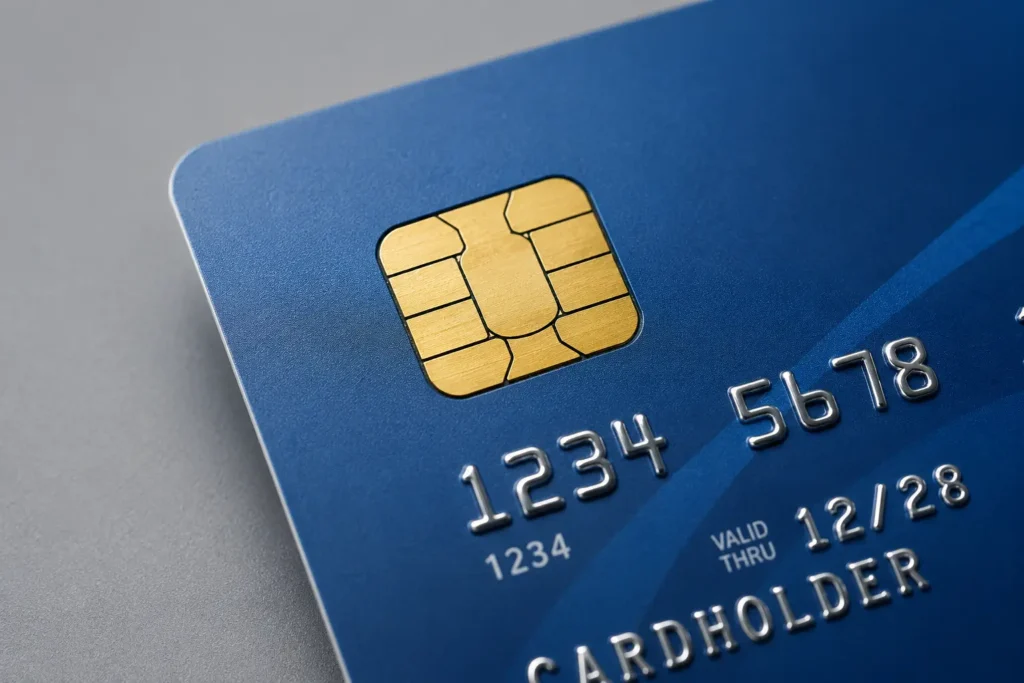
The shift from magnetic stripe cards to EMV (Europay, Mastercard, Visa) chip cards represents one of the most consequential advances in U.S. payment security in recent decades. EMV chips generate a unique, one-time transaction code — called a cryptogram — for each individual purchase. Unlike static data stored on a magnetic stripe, this dynamic cryptogram cannot be reused, which makes skimmed chip data essentially worthless to fraudsters attempting to produce counterfeit cards.
The United States began its formal EMV rollout in October 2015, when card networks transferred liability for counterfeit fraud losses to merchants who had not yet upgraded to chip-capable terminals. Following this change, Visa reported a 76% reduction in counterfeit fraud at chip-activated U.S. merchant locations between December 2015 and December 2018. As of 2024, virtually all credit cards issued in the U.S. carry EMV chips, and chip-capable point-of-sale terminals are standard across most major retail categories.
Card Verification Value (CVV/CVC)
The three- or four-digit security code printed on a credit card — referred to as the Card Verification Value (CVV) by Visa, or the Card Verification Code (CVC) by Mastercard — serves as a secondary authentication factor in card-not-present transactions, such as online or telephone purchases.
Unlike the primary account number or expiration date, the CVV is prohibited from being stored by merchants under Payment Card Industry Data Security Standard (PCI DSS) rules. This means that even when a merchant database is breached and stored card data is exposed, the CVV is typically not among the compromised information — a meaningful structural protection for cardholders. However, CVVs remain vulnerable to real-time capture through phishing attacks, keyloggers, and other methods that intercept data during the checkout process before it reaches the payment processor.
Contactless Payments and Tokenization
Contactless credit card payments — enabled through near-field communication (NFC) technology — rely on tokenization to protect account data during the transaction. Tokenization replaces the cardholder’s actual account number, known as the Primary Account Number (PAN), with a randomly generated substitute value called a token. This token is transmitted during the transaction rather than the real card number.
Even if intercepted, a token is mathematically tied to a specific device and merchant context, rendering it unusable outside of that environment. The same tokenization infrastructure underpins mobile payment platforms such as Apple Pay and Google Pay, where card credentials are stored as device-specific tokens rather than actual account numbers. EMVCo, the global body managing payment technology standards, maintains the specifications governing token provisioning and lifecycle management that major U.S. card networks follow.
Virtual Card Numbers
Several U.S. card issuers offer virtual card numbers (VCNs) — temporary, single-use or merchant-specific account numbers generated from a real card account — for use in online purchases. A VCN can be configured with spending limits, expiration constraints, or merchant-locking parameters. Because a VCN operates independently from the primary account number, it limits the exposure of the real account to online merchant environments where data security practices vary widely.
Federal Legal Protections for Credit Cardholders
The Fair Credit Billing Act (FCBA)
The Fair Credit Billing Act, enacted in 1974 as an amendment to the Truth in Lending Act (15 U.S.C. § 1601 et seq.), establishes a federal framework for resolving billing errors on open-end credit accounts, including credit cards. This statute defines the procedural rights and time limits that govern the dispute process.
Under the FCBA:
- Cardholders have 60 days from the date the billing statement containing the disputed charge was mailed to submit a written billing dispute to the card issuer’s designated billing inquiry address.
- The card issuer must acknowledge the dispute in writing within 30 days of receiving it.
- The issuer must resolve the dispute within two billing cycles, not to exceed 90 days from receipt of the dispute notice.
- Cardholder liability for unauthorized charges is capped at $50 under federal law, regardless of the total amount fraudulently charged.
The Consumer Financial Protection Bureau (CFPB) holds primary regulatory authority over FCBA compliance by card issuers under the Dodd-Frank Wall Street Reform and Consumer Protection Act of 2010 (Pub. L. 111-203). The CFPB’s website (consumerfinance.gov) provides official dispute guidance and templates.
Network Zero Liability Policies
Beyond the federal floor established by the FCBA, major card networks — including Visa, Mastercard, American Express, and Discover — maintain voluntary zero liability policies. These policies generally eliminate cardholder financial responsibility for unauthorized transactions made without the cardholder’s permission, subject to the issuer’s specific terms and prompt fraud reporting.
Zero liability protections are network and issuer policies, not federal statutes. Their precise scope and any applicable exclusions — such as transactions involving gross negligence as defined by the issuer — vary across products and issuers. The exact terms governing any individual account are contained in that account’s cardholder agreement.
How Issuers Detect and Respond to Fraud
AI-Driven Transaction Monitoring
Modern U.S. card issuers deploy machine learning models that analyze transaction data in real time to assess fraud risk. Variables commonly evaluated include geographic location, purchase category, transaction time, spending velocity, and historical account behavior patterns. These systems operate continuously and are calibrated to balance two competing error types: false positives (legitimate transactions declined) and false negatives (fraudulent transactions approved).
When a transaction triggers risk thresholds, the issuer’s system may decline the transaction outright, approve it with a step-up authentication request, or flag it for post-authorization human review.
Real-Time Alerts and Cardholder Notifications
Most major U.S. card issuers offer opt-in transaction alert systems that deliver email, SMS, or push notification confirmations for each transaction in real time or near-real time. These alerts allow cardholders to identify unauthorized activity quickly, which directly supports faster dispute filing and limits the window during which additional fraud can accumulate.
The CFPB has highlighted real-time notification tools as a practical component of consumer fraud response, noting that timely detection reduces the complexity of dispute resolution.
3D Secure Authentication
3D Secure (3DS) is a messaging protocol that adds an authentication layer to online card transactions. The current version — 3D Secure 2 (3DS2), developed and maintained by EMVCo — exchanges risk data between the merchant, the card network, and the issuer’s access control server during the checkout process.
For low-risk transactions, this risk assessment occurs invisibly and the purchase proceeds without cardholder friction. For higher-risk transactions, the issuer may request step-up authentication, such as a one-time passcode sent to the cardholder’s registered phone number. Visa implements 3DS2 under the brand name Visa Secure; Mastercard implements it as Mastercard Identity Check. Merchant participation in the U.S. is not universally mandated, so 3DS2 protection is not applied uniformly across all online transactions.
Common Types of Credit Card Fraud
The table below summarizes the most frequently documented forms of credit card fraud in the U.S., the mechanisms through which each occurs, and the primary security defenses associated with each type.
| Fraud Type | How It Occurs | Primary Defense |
|---|---|---|
| Counterfeit Card Fraud | Magnetic stripe data is cloned onto a fake card using a skimming device | EMV chip (dynamic cryptogram cannot be reused) |
| Card-Not-Present (CNP) Fraud | Stolen card data (number, expiration, CVV2) is used for online or phone purchases | CVV2 verification, 3D Secure, tokenization |
| Account Takeover | Fraudster gains control of an existing account through stolen login credentials or social engineering | Two-factor authentication, issuer fraud monitoring |
| Phishing / Social Engineering | Cardholder is deceived into disclosing card data via fraudulent emails, calls, or websites | Cardholder awareness, issuer alert systems |
| Physical Skimming | Hardware device placed on ATM or payment terminal reads magnetic stripe data | EMV chip, contactless NFC payments |
| Synthetic Identity Fraud | Fraudster combines real and fabricated personal data to open new credit accounts | Issuer identity verification and underwriting controls |
The FTC’s Consumer Sentinel Network data identifies card-not-present fraud as an increasingly dominant fraud category as counterfeit in-person fraud has declined following broad EMV adoption in the U.S.
Key Terms Glossary
EMV Chip: A microchip embedded in payment cards that generates a unique transaction cryptogram for each purchase, making card counterfeiting functionally ineffective at chip-capable terminals.
Tokenization: The process of replacing sensitive card account data with a non-sensitive substitute (token) that has no usable value outside its specific transaction context.
CVV/CVC: A 3- or 4-digit security code printed on a credit card used to verify card-not-present transactions. Under PCI DSS rules, merchants may not store this value after a transaction is authorized.
3D Secure (3DS2): An authentication protocol developed by EMVCo that adds a risk-assessment and verification layer to online credit card transactions.
PCI DSS: Payment Card Industry Data Security Standard — a set of data security requirements established by the PCI Security Standards Council governing how merchants and payment processors handle cardholder data.
FCBA: Fair Credit Billing Act — the federal statute that establishes billing dispute procedures and caps cardholder liability for unauthorized credit card charges at $50.
Zero Liability: A card network or issuer policy that eliminates cardholder financial responsibility for unauthorized transactions, subject to specific conditions defined in the cardholder agreement.
NFC (Near-Field Communication): Short-range wireless technology that enables contactless payment transactions between a card or device and a payment terminal.
Primary Account Number (PAN): The full card account number embossed or encoded on a credit card, which tokenization is designed to protect from exposure during transactions.
Regulatory and Legal Context
Credit card security in the United States is shaped by a layered framework of federal statutes, regulatory agency oversight, and private industry standards.
At the federal statutory level, the Fair Credit Billing Act (15 U.S.C. § 1666 et seq.) and the Truth in Lending Act (TILA) establish minimum consumer protections and billing dispute rights for credit card accounts. The CFPB holds primary supervisory and enforcement authority over card issuers under these statutes, as granted by the Dodd-Frank Act (Pub. L. 111-203).
The Federal Trade Commission (FTC) oversees broader identity theft enforcement and consumer fraud under the FTC Act (15 U.S.C. § 45). The FTC operates IdentityTheft.gov as an official consumer recovery resource and publishes annual fraud and identity theft data through the Consumer Sentinel Network.
The Gramm-Leach-Bliley Act (GLBA) (Pub. L. 106-102) requires financial institutions to explain their information-sharing and data protection practices to customers, with enforcement authority distributed across the FTC and federal banking regulators.
At the industry level, the PCI Security Standards Council — a private body founded by Visa, Mastercard, American Express, Discover, and JCB — maintains the PCI DSS, which sets data security requirements for all entities that process, store, or transmit cardholder data. PCI DSS compliance is contractually required by card networks rather than mandated by federal law.
Summary
Credit card security in the United States functions through three interconnected layers: physical card features, digital transaction protections, and federal legal safeguards.
EMV chip technology substantially reduced counterfeit in-person fraud by replacing static magnetic stripe data with dynamic, one-time transaction cryptograms. Tokenization and 3D Secure protocols extend comparable dynamic-data protections to contactless and online transactions. CVV codes add a secondary verification layer for card-not-present purchases. Virtual card numbers provide additional account separation for online use.
Federal law — principally the FCBA — caps cardholder liability for unauthorized credit card charges at $50, while major card networks have adopted voluntary zero liability policies that go beyond this minimum. The CFPB enforces cardholder billing rights and the FCBA, while the FTC tracks and responds to identity theft and fraud trends nationally.
Issuers deploy AI-based transaction monitoring, real-time alert systems, and 3D Secure authentication to identify and interrupt fraudulent activity. Despite these layered defenses, card-not-present fraud and account takeover remain active threat areas as online commerce continues to grow and payment environments evolve.
Frequently Asked Questions
1. What is the federal liability limit for unauthorized credit card charges?
Under the Fair Credit Billing Act (FCBA), 15 U.S.C. § 1643, cardholder liability for unauthorized credit card charges is capped at $50, regardless of the total fraudulent amount. This means a cardholder who promptly reports unauthorized activity is responsible for no more than $50 of those charges under federal law. Many card issuers and card networks go further through voluntary zero liability policies, which in practice eliminate financial liability for unauthorized transactions in most circumstances. The $50 federal cap applies specifically to credit cards; debit card liability under the Electronic Fund Transfer Act (EFTA) operates under different rules and depends heavily on how quickly the fraud is reported to the issuer.
2. How does an EMV chip prevent credit card fraud?
An EMV chip generates a unique, one-time cryptographic code — called a transaction cryptogram — for each individual purchase. Unlike a magnetic stripe, which stores fixed data that can be read and duplicated with skimming equipment, the chip’s dynamic cryptogram cannot be reused or replicated for future transactions. Even if a fraudster intercepted the transaction data, the cryptogram would be invalid for any subsequent use. This property makes chip-based skimming functionally ineffective at producing counterfeit cards that work at EMV-capable terminals, which is why widespread U.S. EMV adoption correlated with a significant reduction in counterfeit card fraud at physical point-of-sale locations.
3. What is tokenization and how does it protect card data?
Tokenization replaces a cardholder’s actual account number (Primary Account Number, or PAN) with a randomly generated substitute value called a token. This token is transmitted during a transaction instead of the real card number. Because the token is mathematically bound to specific contextual variables — such as the device or merchant — it has no usable value if intercepted outside of its intended environment. Tokenization is the core security mechanism underlying contactless payments and mobile wallet platforms. Even in the event of a data breach at a merchant or payment processor handling a tokenized value, the real card number cannot be reconstructed from the token alone.
4. What is the difference between CVV1 and CVV2?
CVV1 (also called CVC1) is encoded within the magnetic stripe of a credit card and is verified during in-person swipe transactions. CVV2 (CVC2) is the printed 3- or 4-digit code visible on the physical card surface — three digits on the back of most Visa and Mastercard cards, or four digits on the front of American Express cards. CVV2 is specifically used to verify card-not-present transactions, such as online or telephone purchases where the physical card is not swiped or inserted. Under PCI DSS rules, merchants are prohibited from storing CVV2 data after a transaction is authorized, which limits what cardholder information is exposed in the event of a merchant database breach.
5. What is 3D Secure and how is it used in online transactions?
3D Secure (3DS) is an authentication protocol that adds a verification layer to online credit card purchases. The current version — 3D Secure 2 (3DS2), developed by EMVCo — exchanges real-time risk data between the merchant, card network, and the issuer’s authentication system during checkout. For most low-risk transactions, this exchange occurs invisibly and the transaction proceeds without requiring cardholder interaction. For transactions flagged as higher risk, the issuer may request step-up authentication, such as a one-time passcode sent to the cardholder’s registered phone number. Visa implements 3DS2 as “Visa Secure” and Mastercard as “Mastercard Identity Check.” Merchant participation varies in the U.S., as implementation is not universally required.
6. How should a cardholder dispute an unauthorized credit card charge under federal law?
Under the Fair Credit Billing Act, cardholders must send a written dispute to the card issuer’s billing inquiry address — which is distinct from the payment address — within 60 days of the date the statement containing the disputed charge was mailed. The written dispute must include the cardholder’s name, account number, a description of the billing error, and the dollar amount in question. The issuer must acknowledge receipt of the dispute within 30 days and resolve it within two billing cycles, not to exceed 90 days from receipt. During the investigation period, the issuer may not attempt to collect the disputed amount or report it as delinquent to credit bureaus. The CFPB provides detailed guidance and sample dispute letters at consumerfinance.gov.
7. Does zero liability protection cover all types of credit card fraud?
Zero liability policies — offered by major networks including Visa, Mastercard, American Express, and Discover — generally cover unauthorized transactions made without the cardholder’s permission. Specific exclusions may apply, including transactions in which the cardholder directly participated, situations where the cardholder shared account credentials, or cases involving gross negligence as defined by the issuer’s terms and conditions. Because zero liability is a card network and issuer policy rather than a federal statute, precise terms and any exclusions vary across products and issuers. The cardholder agreement for a specific account contains the definitive terms governing that account’s zero liability protection.
8. How does card-not-present fraud differ from in-person credit card fraud?
Card-not-present (CNP) fraud involves the unauthorized use of credit card data — typically the account number, expiration date, and CVV2 — in environments where the physical card is not required, such as online purchases or telephone orders. Because EMV chip technology applies only to in-person transactions at chip-capable terminals, it does not prevent CNP fraud. Primary defenses against CNP fraud include CVV2 verification at checkout, 3D Secure authentication during online purchases, AI-based issuer transaction monitoring, and tokenization when payments process through digital wallet environments. The FTC’s Consumer Sentinel Network data shows that unauthorized account charges — a large proportion of which reflect CNP activity — represent the most commonly reported form of identity theft in the U.S., a pattern that has grown more pronounced as counterfeit in-person fraud has declined.
Sources
Federal Trade Commission. Consumer Sentinel Network Data Book 2023. FTC.gov. https://www.ftc.gov/reports/consumer-sentinel-network-data-book-2023
Consumer Financial Protection Bureau. Disputing Credit Card Charges. ConsumerFinance.gov. https://www.consumerfinance.gov/ask-cfpb/what-do-i-do-if-i-think-there-is-an-error-on-my-credit-card-bill-en-32/
Consumer Financial Protection Bureau. What is a credit card security code? ConsumerFinance.gov. https://www.consumerfinance.gov/ask-cfpb/what-is-a-credit-card-security-code-en-15/
U.S. House of Representatives. 15 U.S.C. § 1601 et seq. — Truth in Lending Act (including the Fair Credit Billing Act). USC.house.gov. https://uscode.house.gov/view.xhtml?path=/prelim@title15/chapter41/subchapter1&edition=prelim
Federal Trade Commission. IdentityTheft.gov: Recover from Identity Theft. IdentityTheft.gov. https://www.identitytheft.gov/
EMVCo. EMV® 3-D Secure Specification and Overview. EMVCo.com. https://www.emvco.com/emv-technologies/3d-secure/
EMVCo. EMV® Payment Tokenisation Specification — Technical Framework. EMVCo.com. https://www.emvco.com/emv-technologies/payment-tokenisation/
PCI Security Standards Council. PCI Data Security Standard (PCI DSS) Overview. PCISecurityStandards.org. https://www.pcisecuritystandards.org/standards/pci-dss/
Federal Reserve. The Federal Reserve Payments Study: 2022 Annual Supplement. FederalReserve.gov. https://www.federalreserve.gov/paymentsystems/fr-payments-study.htm
Federal Trade Commission. What to Know About Credit Card Fraud. Consumer.ftc.gov. https://consumer.ftc.gov/articles/what-know-about-credit-card-fraud
Disclaimer
The content published on CreditPur (creditpur.com) is intended for educational and informational purposes only. It does not constitute financial, legal, or professional advice of any kind. No content on this website should be interpreted as a recommendation, endorsement, or suggestion to apply for any financial product, make any financial decision, or take any specific action. Credit card terms, protections, and features vary by issuer, product, and applicable law. Federal laws and regulatory guidance referenced in this article are subject to change. Readers are encouraged to consult official federal agency resources — including the Consumer Financial Protection Bureau (consumerfinance.gov), the Federal Trade Commission (ftc.gov), and IdentityTheft.gov — as well as qualified legal and financial professionals, before making financial decisions. CreditPur is not affiliated with any credit card issuer, card network, financial institution, or government agency.