
Table of Contents
Introduction
In 2024, credit cards accounted for 35% of all consumer payments by number, while debit cards made up another 30%, according to the Federal Reserve’s 2025 Diary of Consumer Payment Choice. Combined, these two card types now cover almost two-thirds of every purchase Americans make, from a cup of coffee to a major appliance.
Despite how similar they look at checkout, a credit card and a debit card operate under entirely different financial mechanics, federal laws, and consequences for a person’s credit profile. One involves borrowed money from a financial institution; the other draws directly from funds already sitting in a bank account. That distinction shapes everything from how fraud is handled to whether the card affects a credit score at all.
This article breaks down how each card type functions, what federal regulations govern unauthorized charges and billing disputes, how each interacts with credit reporting, and what costs are typically associated with each — based on information from the Consumer Financial Protection Bureau (CFPB), the Federal Trade Commission (FTC), and the Federal Reserve.
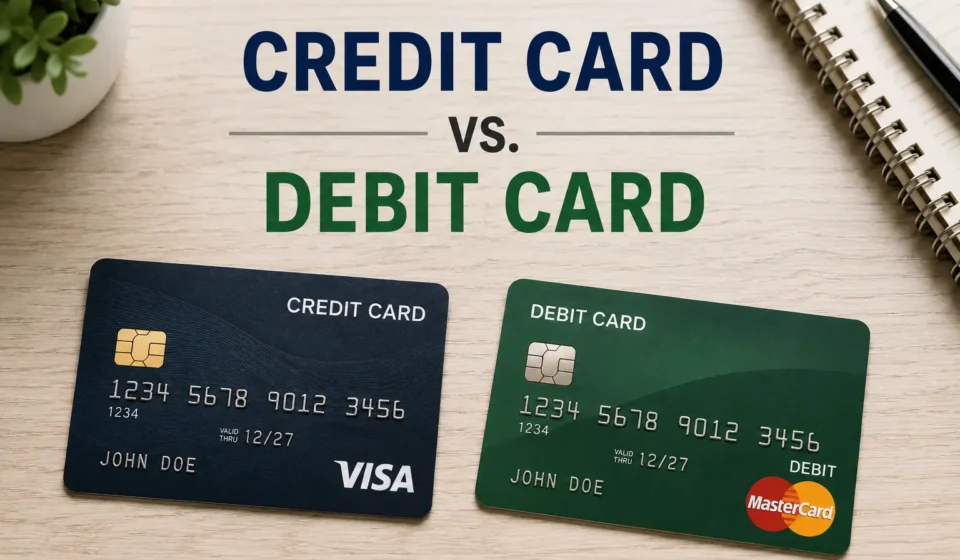
What Is a Credit Card? What Is a Debit Card?
A credit card is a payment device linked to a revolving line of credit extended by a bank, credit union, or other financial institution. Using it means borrowing money up to an approved credit limit, with the expectation that the balance will be repaid, either in full or over time with interest.
A debit card is a payment device linked directly to a checking or other deposit account. Every purchase draws immediately from funds the cardholder already has on deposit. No borrowing occurs, and the issuing bank is not extending credit through the transaction itself.
This single distinction — borrowed funds versus funds already owned — is the root cause of nearly every other difference between the two card types, including how the law treats fraud, how issuers report account activity, and how each interacts with a person’s broader financial profile.
How a Credit Card Works
A credit card account comes with a credit limit, a maximum amount that can be charged at any given time. Purchases accumulate into a statement balance at the end of each billing cycle, and the cardholder receives a bill listing that balance along with a minimum payment due.
Most credit cards include a grace period: if the full statement balance is paid by the due date, no interest is charged on purchases from that cycle. If only part of the balance is paid, the remainder revolves to the next cycle and begins accruing interest, calculated as an annual percentage rate (APR).
According to the Federal Reserve’s G.19 Consumer Credit report, the average APR across all credit card accounts was 21.00% in the first quarter of 2026, while the average APR specifically on accounts that carried a balance and accrued interest was 21.52%. New card offers carried even higher average APRs, reflecting the rate a consumer might face when opening a new account rather than the blended rate across an existing portfolio.
Total U.S. credit card balances are tracked quarterly by the Federal Reserve Bank of New York’s Consumer Credit Panel, part of its Quarterly Report on Household Debt and Credit. That report has noted a seasonal pattern in which card balances typically decline from the fourth quarter of one year into the first quarter of the next, as holiday spending balances get paid down.
How a Debit Card Works
A debit card draws on funds in a linked checking or savings account at the moment of the transaction. Most debit cards can be processed two ways: as a PIN-based transaction, which routes through the debit network instantly, or as a signature-based “credit” transaction, which routes through a card network like Visa or Mastercard but still pulls money from the same deposit account. Selecting the “credit” option at checkout changes how the transaction is processed; it does not turn the debit card into an actual credit account.
Because no money is borrowed, debit card purchases do not generate interest charges. However, if an account does not have enough available funds, the transaction may either be declined or, if the bank has an overdraft program in place, approved anyway — resulting in a negative account balance and a potential overdraft fee.
The overdraft fee landscape has shifted in recent years. In December 2024, the CFPB finalized a rule that would have capped overdraft fees at very large financial institutions at $5 or at the institution’s documented cost, with an effective date of October 2025. Congress subsequently overturned that rule under the Congressional Review Act through S.J.Res. 18, which was signed into law. As a result, there is no federal cap on overdraft fees as of 2026, and large bank overdraft fees, where charged, have historically clustered around $35, though overdraft fee revenue and policies vary significantly by institution.
Fraud Protection and Liability for Unauthorized Charges
Federal law treats unauthorized credit card charges differently from unauthorized debit card transactions, and the distinction matters because the financial exposure can be substantially different.
Credit cards are governed by the Truth in Lending Act (TILA) and its implementing Regulation Z, along with the Fair Credit Billing Act (FCBA), a 1974 amendment to TILA. Under these rules, a cardholder’s maximum liability for unauthorized charges is $50, regardless of how long it takes to report the issue, and many issuers voluntarily reduce that liability to $0 through zero-liability policies. If a card is reported lost or stolen before it is used fraudulently, the cardholder owes nothing for any unauthorized use that follows.
Debit cards fall under the Electronic Fund Transfer Act (EFTA) and its implementing Regulation E, which uses a tiered liability structure based on how quickly the loss is reported:
- Reported within 2 business days of learning of the loss: liability capped at $50
- Reported between 2 and 60 days after the statement date showing the unauthorized transfer: liability capped at $500
- Reported more than 60 days after that statement: liability can be unlimited
This tiered structure means that a delayed report on a debit card carries far greater financial risk than a delayed report on a credit card, where the $50 cap applies regardless of timing under the FCBA.
Impact on Credit History and Credit Score

Credit card accounts are generally reported to the three nationwide credit reporting agencies — Equifax, Experian, and TransUnion — on a regular basis. That reporting includes the credit limit, current balance, and payment history, all of which feed into credit utilization and payment history, two of the largest factors in most credit scoring models.
Debit card transactions are not a form of credit, so they are not reported to credit bureaus and do not appear on a credit report. A checking account’s balance, overdraft history, or spending pattern through a debit card generally has no direct bearing on a FICO Score or VantageScore, since those scores are calculated using credit accounts, not deposit account activity.
Some financial institutions and credit-building programs have introduced services that allow alternative data, such as utility or rent payments made from a checking account, to be voluntarily reported to a credit bureau. These programs are distinct from standard debit card use itself and require separate enrollment.
Fees and Other Costs
Credit cards may carry annual fees, foreign transaction fees, late payment fees, and interest charges on revolving balances, though many credit cards, particularly no-annual-fee cards, avoid some of these costs entirely if the balance is paid in full each cycle. Debit cards typically carry fewer recurring fees directly tied to the card itself, since there is no borrowing involved, though the linked checking account may carry monthly maintenance fees, ATM fees, or overdraft fees depending on the account terms.
Credit Card vs. Debit Card: Side-by-Side Comparison
| Feature | Credit Card | Debit Card |
|---|---|---|
| Funding source | Bank-issued revolving credit line | Linked checking or deposit account |
| Whose money is spent | Borrowed funds | Account holder’s own funds |
| Builds credit history | Generally yes, through bureau reporting | Generally no |
| Governing federal law | Truth in Lending Act (TILA) / Regulation Z | Electronic Fund Transfer Act (EFTA) / Regulation E |
| Billing dispute framework | Fair Credit Billing Act (FCBA) | Regulation E error-resolution procedures |
| Liability if reported within 2 business days | Up to $50 (often $0 with issuer policy) | Up to $50 |
| Liability if reported 2–60 days later | Up to $50 | Up to $500 |
| Liability if reported after 60 days | Up to $50 | Potentially unlimited |
| Interest charges | Yes, on unpaid revolving balances | No interest on the card itself |
| Risk if funds/credit run short | Transaction declined at credit limit | Possible overdraft or declined transaction |
| Typical rewards programs | Common (cash back, points, miles) | Less common, often limited or absent |
Key Terms and Glossary
Annual Percentage Rate (APR): The yearly interest rate charged on revolving credit card balances.
Revolving Credit: A credit line that can be borrowed against, repaid, and borrowed against again up to an approved limit.
Regulation Z: The Federal Reserve and CFPB regulation implementing the Truth in Lending Act, governing credit card disclosures and billing.
Regulation E: The CFPB regulation implementing the Electronic Fund Transfer Act, governing debit card and other electronic fund transfers.
Fair Credit Billing Act (FCBA): A 1974 federal law amending TILA that gives credit cardholders the right to dispute billing errors and limits liability for unauthorized charges.
Credit Utilization Ratio: The percentage of available credit currently in use, a key factor in most credit scoring models.
Overdraft: A transaction approved by a bank despite insufficient account funds, typically resulting in a negative balance and possible fee.
Grace Period: The interest-free window during which a credit card statement balance can be paid in full without incurring finance charges.
Interchange Fee: A fee paid by a merchant’s bank to a cardholder’s bank for processing a card transaction, with rates that differ between credit and debit networks.
Regulatory and Legal Context
Credit cards and debit cards sit under two separate federal regulatory frameworks, each enforced primarily by the CFPB and FTC.
Credit cards fall under the Truth in Lending Act (TILA) of 1968 and its implementing Regulation Z, which require standardized disclosures of APR, fees, and terms. The Fair Credit Billing Act (FCBA) of 1974 added billing-dispute rights and the $50 unauthorized-charge cap. The Credit Card Accountability, Responsibility and Disclosure (CARD) Act of 2009 layered on additional protections, including restrictions on retroactive interest rate increases and stricter requirements for extending credit to young adults.
Debit cards and other electronic fund transfers fall under the Electronic Fund Transfer Act (EFTA) of 1978 and its implementing Regulation E, administered by the CFPB. Regulation E establishes the tiered liability structure for unauthorized transfers and sets error-resolution timelines that banks must follow when a consumer disputes a transaction.
Overdraft practices tied to debit cards have been an active regulatory area. The CFPB finalized a rule in December 2024 to cap overdraft fees at large financial institutions, but Congress repealed that rule in 2025 under the Congressional Review Act, leaving overdraft fee structures to individual institution policy as of 2026, subject to existing Regulation E and Regulation Z disclosure requirements.
Summary
Credit cards and debit cards may look alike, but they function on fundamentally different financial models: one borrows money, the other spends money already on deposit. That difference drives separate legal protections, with credit cards governed by the FCBA and Regulation Z and debit cards governed by Regulation E’s tiered liability system. It also drives different consequences for credit history, since credit card activity is typically reported to credit bureaus while debit card activity generally is not. Interest charges, overdraft exposure, and rewards structures further separate the two, even though both remain central to how the majority of U.S. consumer payments are made.
Frequently Asked Questions
What is the main difference between a credit card and a debit card?
A credit card draws on a line of credit extended by a bank, meaning the cardholder is borrowing money that must eventually be repaid, with interest charged on any balance not paid in full. A debit card draws directly from funds already held in a linked checking or deposit account, so no borrowing occurs. This core difference affects how each card is regulated, how fraud liability is calculated, and whether the card has any bearing on a credit report.
Does using a debit card build credit?
Generally, no. Debit card transactions are not a form of credit and are not reported to the three nationwide credit bureaus — Equifax, Experian, and TransUnion. As a result, regular debit card use, on its own, typically does not influence a FICO Score or VantageScore. Some financial products link bank account data to voluntary credit-reporting programs, but these are separate services from standard debit card use.
What happens if a credit card is lost or stolen?
Under the Fair Credit Billing Act, a cardholder’s maximum liability for unauthorized charges made with a lost or stolen credit card is $50, and many issuers offer zero-liability policies that reduce this further. If the card is reported missing before any unauthorized use occurs, federal law states the cardholder is not responsible for any subsequent unauthorized charges.
What happens if a debit card is lost or stolen?
Debit cards are governed by Regulation E, which uses a tiered liability system. Liability is capped at $50 if the loss is reported within two business days of discovery, rises to a $500 cap if reported within 60 days of the relevant account statement, and can become unlimited if reported after that 60-day window.
Can a debit card be used as a credit card?
Most debit cards can be processed as either a PIN-based debit transaction or a signature-based transaction routed through a card network like Visa or Mastercard, sometimes referred to as running it “as credit.” Choosing this option changes how the transaction is processed, but the funds still come directly from the linked deposit account, and the transaction does not appear on a credit report.
Do credit cards and debit cards both charge interest?
Credit cards can charge interest on any balance that is not paid in full by the due date, with the average APR across all accounts at 21.00% and the average APR on interest-accruing accounts at 21.52% as of the first quarter of 2026, according to Federal Reserve data. Debit cards do not charge interest, since no borrowing takes place; the only related cost would be an overdraft fee if the linked account lacks sufficient funds.
What federal law covers billing disputes on a credit card?
The Fair Credit Billing Act gives credit cardholders the right to dispute billing errors, including unauthorized charges, incorrect amounts, and charges for goods that were never delivered. Disputes generally must be submitted within 60 days of receiving the statement showing the error, and the creditor must investigate within set timeframes defined by the FCBA and Regulation Z.
Can a credit card or debit card result in a negative balance?
A credit card cannot create a negative cash balance in the traditional sense, since the limit on spending is the credit line itself; attempting to exceed it typically results in a declined transaction or, less commonly, an over-limit fee depending on the cardholder agreement. A debit card can result in a negative account balance if the linked checking account allows overdrafts, since the bank may approve a transaction even when funds are insufficient, leading to a negative balance and a possible overdraft fee.
Sources
- Consumer Financial Protection Bureau – “Am I responsible for unauthorized charges if my credit cards are lost or stolen?” – https://www.consumerfinance.gov/ask-cfpb/am-i-responsible-for-unauthorized-charges-if-my-credit-cards-are-lost-or-stolen-en-29/
- Consumer Financial Protection Bureau – Regulation E, 12 CFR § 1005.6, Liability of Consumer for Unauthorized Transfers – https://www.consumerfinance.gov/rules-policy/regulations/1005/6/
- Consumer Financial Protection Bureau – Regulation Z, 12 CFR § 1026.12, Special Credit Card Provisions – https://www.consumerfinance.gov/rules-policy/regulations/1026/12/
- Federal Trade Commission – “Lost or Stolen Credit, ATM, and Debit Cards” – https://consumer.ftc.gov/lost-or-stolen-credit-atm-debit-cards
- Federal Trade Commission – “Using Credit Cards and Disputing Charges” – https://consumer.ftc.gov/articles/using-credit-cards-and-disputing-charges
- Federal Reserve Board – Consumer Credit – G.19 Statistical Release – https://www.federalreserve.gov/releases/g19/current/
- Federal Reserve Financial Services – “2025 Findings from the Diary of Consumer Payment Choice” – https://www.frbservices.org/news/research/2025-findings-from-the-diary-of-consumer-payment-choice
- Federal Reserve Bank of New York – Quarterly Report on Household Debt and Credit – https://www.newyorkfed.org/microeconomics/hhdc
- Congress.gov – “Congress Repeals CFPB’s Overdraft Rule” (CRS Report IN12513) – https://www.congress.gov/crs-product/IN12513
- Cornell Law School, Legal Information Institute – “Fair Credit Billing Act (FCBA)” – https://www.law.cornell.edu/wex/fair_credit_billing_act_(fcba)
Disclaimer
This article is provided for general educational and informational purposes only. It does not constitute financial, legal, or credit advice, and it should not be relied upon as a substitute for guidance from a qualified financial professional, attorney, or the official publications of the financial institution or government agency involved. Interest rates, fee structures, and regulations referenced in this article reflect data available as of the last updated date above and are subject to change. Readers should consult official sources, including the Consumer Financial Protection Bureau and the Federal Trade Commission, and their own card issuer or financial institution, for current terms and requirements.