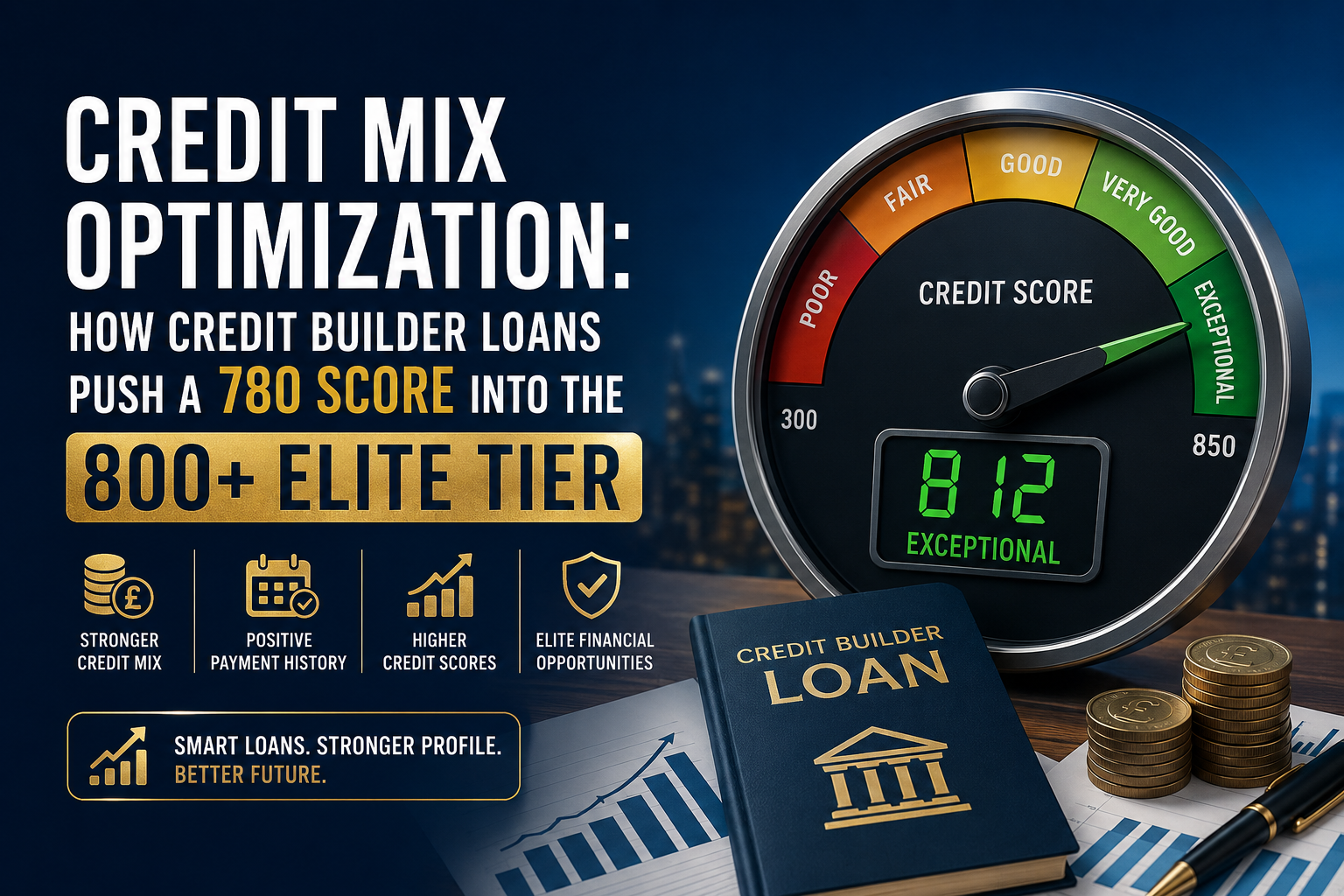
Credit mix optimization has become one of the most advanced strategies for borrowers aiming to move beyond a strong 780 score and enter the elite 800+ category. Modern scoring systems like FICO 10T now analyze repayment behavior, installment diversity, and trended financial patterns in ways traditional scoring models never did.
Introduction
For many consumers, a 780 credit score already feels excellent. However, lenders in the USA and UK increasingly reserve premium lending opportunities for borrowers with deeper behavioral strength.
This includes:
- Lower mortgage interest rates
- Higher unsecured credit limits
- Private banking access
- Premium rewards approvals
- Better underwriting treatment
One of the most overlooked techniques involves using credit builder loans and installment tradelines to optimize credit mix behavior.
Today’s underwriting engines no longer rely only on static snapshots. Instead, they evaluate:
- Debt composition
- Installment repayment history
- Balance reduction patterns
- Financial consistency over time
- Risk diversification
Why Credit Mix Optimization Matters
Credit mix optimization refers to strategically balancing different account types on your credit report.
Modern scoring systems reward borrowers who successfully manage multiple forms of debt, including:
- Revolving credit cards
- Installment loans
- Mortgages
- Auto loans
- Credit builder accounts
Many high-income borrowers fail to reach the elite credit bracket because their profile lacks installment diversity.
How FICO 10T Changed Credit Scoring
Recent developments in FICO 10T introduced trended data analysis into mainstream underwriting.
Instead of evaluating only current balances, lenders now study:
- Historical repayment behavior
- Balance reduction speed
- Long-term financial stability
- Installment utilization patterns
Installment Utilization Formula

(Current Loan Balance ÷ Original Loan Amount) × 100
This means a borrower who actively reduces installment balances may appear lower risk than someone with no installment history at all.
Step 1: Strategic Installment Loan Positioning
Selecting the Right Credit Builder Loan
Not all installment loans provide equal scoring benefits.
The strongest credit builder products usually:
- Report to all major bureaus
- Have low balances
- Offer long repayment periods
- Maintain predictable monthly reporting
| Feature | Recommended Structure |
|---|---|
| Loan Amount | $500–$3,000 |
| Term Length | 12–36 Months |
| Monthly Payment | Under 5% of income |
| Reporting | All major credit bureaus |
Smaller installment loans often outperform larger unsecured loans because scoring systems prioritize repayment behavior over loan size.
Step 2: Installment Utilization Engineering
Most consumers understand revolving utilization. Very few understand installment utilization optimization.
Advanced scoring systems favor installment accounts that:
- Remain active
- Show aggressive balance reduction
- Maintain perfect payment history
The Sweet Spot Strategy
Many advanced credit analysts believe optimal installment behavior appears when:
- 5%–30% of the original balance remains
- The account is still open
- No late payments exist
Example:

Original Loan = $2,000
Current Balance = $300

Installment Utilization = 15%
This creates a strong positive repayment trajectory in modern underwriting systems.
Step 3: Building an Elite 800+ Credit Profile
Elite credit profiles usually combine:
- Low revolving utilization
- Installment loan diversity
- Long account history
- Minimal inquiries
- Consistent repayment behavior
Example Optimization Scenario
| Before Optimization | After Optimization |
|---|---|
| 780 Credit Score | 812 Credit Score |
| No Installment Accounts | 1 Active Installment Loan |
| 2% Utilization | 1% Utilization |
| Limited Repayment Diversity | Improved Credit Mix |
The score increase often comes from improved underwriting confidence rather than simple point accumulation.
The High-Net-Worth Borrower Paradox
Many wealthy borrowers unintentionally weaken their credit profile because they avoid all forms of debt.
Ironically, completely debt-free profiles can appear less predictable to modern underwriting algorithms.
Strategically managed installment accounts demonstrate:
- Financial discipline
- Repayment reliability
- Structured debt management
- Behavioral stability
Recent Developments in Credit Scoring
Banks and fintech lenders increasingly rely on:
- AI-driven underwriting
- Behavioral scoring systems
- Cash-flow analysis
- Machine learning risk models
Traditional optimization strategies from older scoring systems are becoming less effective.
Today, lenders prioritize:
- Consistency over volume
- Behavior over snapshots
- Repayment quality over income alone
Common Issues and Troubleshooting
Problem: Score Drops After Opening a Loan
Cause: Hard inquiry and reduced average account age.
Solution: Most optimized profiles recover within 3–6 months.
Problem: No Score Increase
Cause: Installment balance remains too high.
Solution: Reduce the principal aggressively while keeping the account active.
Problem: Too Many New Accounts
Cause: Over-optimization triggers risk flags.
Solution: Space applications over longer periods.
Advanced Credit Mix Optimization Techniques
Sophisticated borrowers frequently combine:
- Prime revolving cards
- One installment tradeline
- Mortgage history
- Business credit accounts
- Low inquiry activity
This creates stronger underwriting credibility across multiple lending categories.
Lead Magnet Opportunity
Advanced borrowers can improve results by using an elite credit optimization checklist that tracks:
- Installment utilization ratios
- Credit reporting timing
- Inquiry clustering
- Credit mix balance
- Trended data behavior
This type of value-driven lead magnet performs exceptionally well for financial blogs targeting high-intent readers.
Social Proof Integration
Online finance communities and credit optimization groups increasingly report:
- Higher mortgage approvals
- Premium card approvals
- Lower borrowing costs
- Improved internal bank ratings
among borrowers using installment optimization strategies correctly.
Conclusion
Credit mix optimization is no longer a minor scoring tactic. In modern underwriting environments, it has become a powerful strategy for moving from a strong 780 score into the elite 800+ category.
Strategically managed credit builder loans can provide:
- Improved repayment diversity
- Enhanced underwriting confidence
- Better installment behavior signals
- Stronger long-term credit stability
The future of elite credit scoring depends less on avoiding debt entirely and more on demonstrating intelligent, predictable, and diversified repayment behavior.
For advanced borrowers in the USA and UK, credit mix optimization remains one of the most effective methods for building a truly elite financial profile.