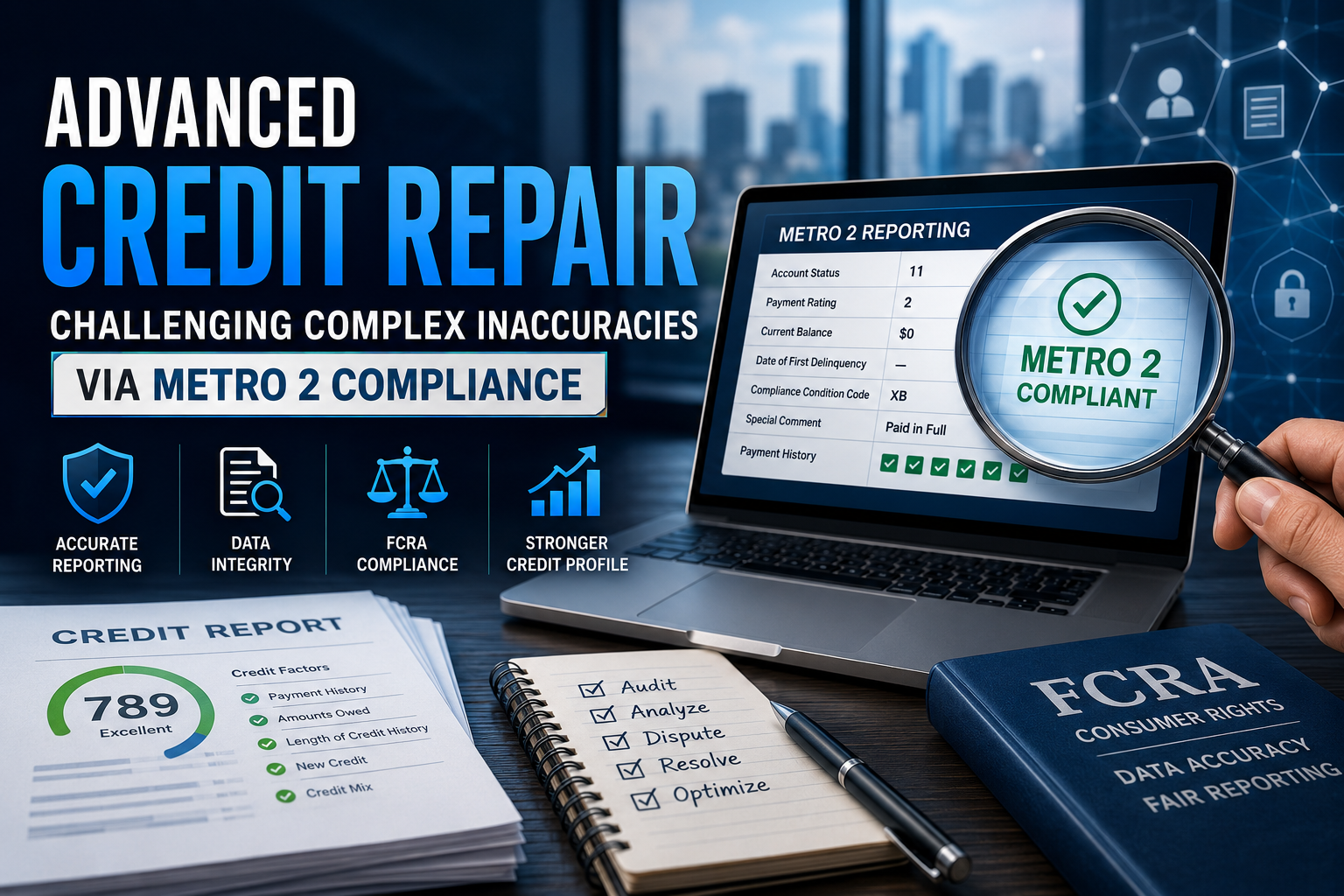
Executive Summary: This advanced technical guide explains how Metro 2 compliance impacts modern credit reporting disputes in the USA and UK markets. Learn how data furnishers encode tradelines, how compliance violations create leverage in advanced credit repair, and how practitioners can challenge complex inaccuracies at the reporting-code level using FCRA, e-OSCAR, and Metro 2 auditing techniques.
Introduction
Advanced Credit Repair has evolved far beyond basic dispute letters and generic consumer complaints. In 2026, the most successful practitioners focus on Metro 2 compliance and structured reporting inconsistencies within the credit reporting ecosystem.
Modern lenders increasingly rely on machine-driven underwriting systems that evaluate trended data, behavioral repayment patterns, and account chronology. Small reporting errors now have significantly greater consequences on approvals, utilization calculations, mortgage pricing, and lending risk models.
This matters because inaccurate Metro 2 reporting can:
- Lower credit scores unnecessarily
- Distort debt-to-income calculations
- Trigger underwriting denials
- Increase lending costs
- Create duplicate derogatory reporting
- Damage long-term credit profiles
This tutorial assumes you already understand:
- FCRA fundamentals
- Basic dispute workflows
- Credit scoring systems
- Tradeline structures
In this guide, you will learn:
- How Metro 2 reporting works
- How to identify technical furnishing errors
- How to build high-level disputes using structured data inconsistencies
- How chronology analysis creates dispute leverage
- How modern furnishers fail compliance audits
Understanding Metro 2 Compliance
Metro 2 is the standardized reporting format developed by the Consumer Data Industry Association (CDIA). It governs how banks, lenders, collection agencies, fintech companies, and debt buyers report account information to:
- Experian
- Equifax
- TransUnion
Each tradeline includes hundreds of machine-readable fields such as:
- Account Status Codes
- Payment Ratings
- Balance Data
- Date of First Delinquency
- Compliance Condition Codes
- Special Comment Codes
- Consumer Information Indicators
Most consumers never see these backend reporting structures. However, advanced practitioners understand that many disputes succeed because the data itself becomes internally inconsistent.
Why Advanced Credit Repair Matters More in 2026
Expansion of Trended Data Models
FICO 10T and VantageScore 4.0 now analyze repayment behavior over time instead of relying solely on static monthly snapshots.
This means inaccurate historical reporting creates amplified downstream scoring consequences.
BNPL Reporting Problems
Buy Now Pay Later providers often operate immature furnishing systems that create:
- Duplicate tradelines
- Incorrect balances
- Improper payment histories
- Inconsistent account statuses
Regulatory Pressure
The CFPB continues increasing scrutiny around:
- Automated dispute investigations
- Data integrity
- Reasonable verification procedures
- Reporting accuracy standards
Step 1: Audit the Tradeline at the Metro 2 Field Level
The first stage of Advanced Credit Repair is reconstructing the tradeline as structured data instead of emotional narrative.
Key Fields to Audit
| Field | Risk Area |
|---|---|
| Account Status Code | Contradictory delinquency states |
| Payment Rating | Historical inconsistency |
| Date of First Delinquency | Re-aging violations |
| Current Balance | Balance inflation |
| Scheduled Monthly Payment | Mathematical mismatch |
| Compliance Condition Code | Bankruptcy conflicts |
Example of Contradictory Status Coding
{
  "AccountStatus": "11",
  "PaymentRating": "5",
  "CurrentBalance": "0",
  "SpecialComment": "Account Paid in Full"
}
Potential issue:
- Balance equals zero
- Account marked paid in full
- Severe derogatory rating remains active
This creates strong dispute leverage because the furnisher must prove historical and structural consistency.
Metro 2 Audit SQL Example
SELECT
 account_number,
 account_status,
 payment_rating,
 current_balance,
 date_closed
FROM tradelines
WHERE
 account_status = '13'
AND current_balance = 0
AND payment_rating > 0;
Step 2: Build Technical Disputes Instead of Generic Letters
Traditional dispute templates are becoming less effective because e-OSCAR systems heavily automate dispute handling.
Modern Advanced Credit Repair strategies focus on:
- Field inconsistencies
- Validation impossibilities
- Chronological conflicts
- Metro 2 compliance failures
Weak Dispute Example
This account is unfair and inaccurate.
Please remove it immediately.
Technical Dispute Example
The reported Account Status conflicts with the Current Balance and
Special Comment designation.

The tradeline reflects:
- Current Balance = $0
- Special Comment = Paid in Full
- Active derogatory Payment Rating remains present

Please provide:
1. Metro 2 validation records
2. Date-specific furnishing documentation
3. Chronology verification
4. Internal account history validation
This forces the furnisher into deeper investigation pathways instead of simple automated verification.
Step 3: Attack Data Integrity Through Chronology Analysis
One of the strongest Advanced Credit Repair methods involves timeline reconstruction.
Many furnishers fail chronology validation because accounts pass through:
- Debt sales
- Legacy system migrations
- Servicing transfers
- Outsourced reporting vendors
- Portfolio acquisitions
Example Chronology Mapping
timeline = [
    {"month": "2023-01", "status": "30 Late"},
    {"month": "2023-02", "status": "60 Late"},
    {"month": "2023-03", "status": "Current"},
    {"month": "2023-04", "status": "Charge Off"}
]
Potential issue:
- Sudden return to current status
- Immediate charge-off progression
- No documented cure period
This may indicate defective furnishing logic or invalid chronology reconstruction.
Advanced Metro 2 Dispute Strategies
Payment Rating Inconsistency Challenges
Many furnishers improperly maintain derogatory Payment Ratings after:
- Settlements
- Loan modifications
- Hardship programs
- Paid closures
Deferred Payment Misreporting
Pandemic-era accommodation reporting created widespread Metro 2 inconsistencies involving:
- Deferred payments coded as late
- Incorrect hardship indicators
- Misreported payment obligations
Duplicate Furnishing Detection
Debt transfers frequently create:
- Original creditor tradelines
- Collection tradelines
- Debt buyer tradelines
Advanced practitioners analyze:
- Ownership chronology
- Balance inheritance
- Reporting authority
- Parallel collection activity
Common Issues and Troubleshooting
Bureau Verifies Despite Clear Inaccuracy
Cause: Automated e-OSCAR verification.
Solution:
- Request Method of Verification
- Escalate directly to furnisher
- File CFPB complaints
- Demand documentary validation
Tradeline Updates Instead of Removal
Cause: Partial inconsistency identified.
Solution:
- Re-audit chronology
- Review historical balances
- Analyze status transitions
- Inspect special comment codes
Multiple Bureaus Show Different Data
Cause: Asynchronous furnishing systems.
Solution:
- Compare bureau snapshots
- Analyze reporting dates
- Review payment histories
- Challenge inconsistent fields
Academic and Regulatory Insights
Research from the CFPB and Urban Institute continues to show that credit reporting inaccuracies remain widespread across consumer files.
Recent machine-learning underwriting systems amplify the consequences of:
- Historical delinquency errors
- Balance distortions
- Timeline inconsistencies
- Duplicate derogatory coding
Advanced practitioners should monitor:
- CFPB enforcement actions
- CDIA Metro 2 updates
- Consent orders involving furnishers
- AI underwriting developments
Free Metro 2 Compliance Toolkit
Download the Advanced Credit Repair Toolkit including:
- Metro 2 Audit Checklist
- Advanced Dispute Templates
- Chronology Analysis Worksheets
- Furnisher Compliance Tracker
Designed specifically for advanced practitioners working with complex reporting inaccuracies.
Conclusion
Advanced Credit Repair is rapidly becoming a technical discipline built around data integrity, chronology analysis, and Metro 2 compliance auditing.
The practitioners who succeed in 2026 will not rely on generic disputes or emotional appeals. They will understand structured furnishing systems, identify inconsistencies at the reporting-code level, and challenge unverifiable data with precision.
As underwriting systems become increasingly dependent on trended behavioral data, even minor reporting inaccuracies can create significant financial consequences.
The future belongs to professionals who can:
- Audit Metro 2 structures
- Analyze chronology inconsistencies
- Challenge defective furnishing logic
- Understand automated verification systems
- Build technically precise disputes
Advanced Credit Repair through Metro 2 compliance is no longer a niche strategy. It is becoming the industry standard for high-level dispute work.