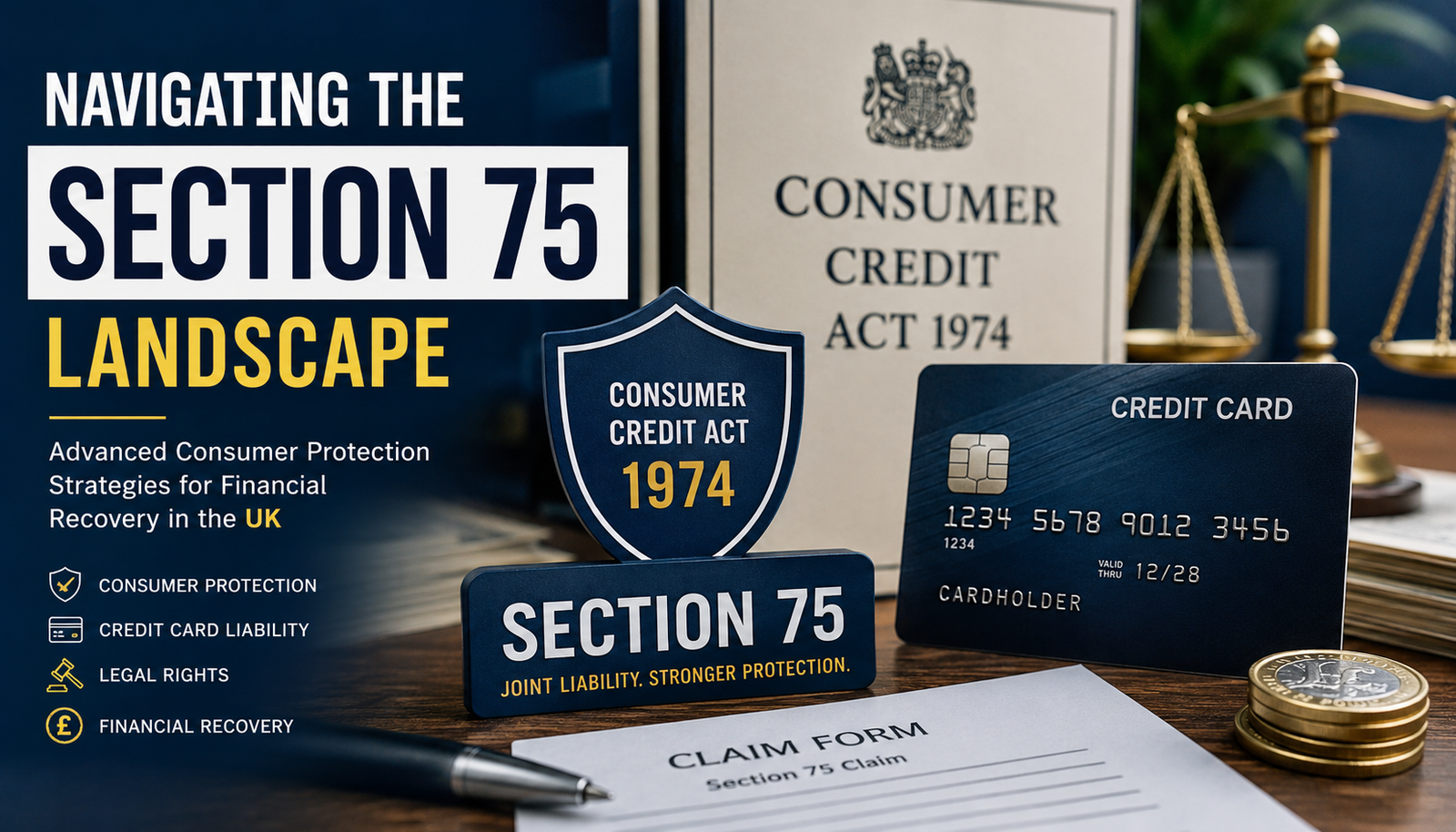
Executive Summary: This advanced guide explores how professionals and financially aware consumers can leverage Section 75 consumer protection under the UK Consumer Credit Act for financial recovery, credit score protection, chargeback optimization, and merchant insolvency disputes in 2026.
Introduction
The financial risk landscape has changed dramatically over the last few years. Merchant insolvencies, subscription scams, cross-border digital transactions, and online fraud schemes have exposed serious weaknesses in modern consumer commerce.
For advanced consumers, Section 75 consumer protection remains one of the strongest legal tools available under the Consumer Credit Act 1974. While most people understand the basics, few know how to strategically optimize Section 75 claims for financial recovery, liquidity preservation, and long-term credit protection.
This guide focuses on advanced implementation techniques, recent developments, and sophisticated recovery strategies designed for experienced users in the UK and USA markets.
- Basic understanding of credit card operations
- Knowledge of chargebacks and consumer disputes
- Familiarity with credit score systems
- Understanding of financial documentation workflows
Understanding the Strategic Importance of Section 75 Consumer Protection
Section 75 creates joint and several liability between the merchant and the credit provider. This means the lender becomes equally responsible when a merchant breaches contract terms or commits misrepresentation.
The strategic advantage is simple: consumers can pursue financially stable credit issuers instead of collapsed or unresponsive merchants.
Why Section 75 Matters More in 2026
- Increasing merchant insolvencies
- Growth of international e-commerce disputes
- AI-powered subscription fraud
- Complex digital service contracts
- Buy Now Pay Later ecosystem expansion
Advanced financial professionals now integrate Section 75 into broader risk management systems rather than treating it as an emergency-only protection mechanism.
Step 1: Building a High-Success Section 75 Claim Framework
Understanding Claim Viability
| Factor | Importance |
|---|---|
| Direct credit relationship | Critical |
| Evidence quality | Critical |
| Merchant solvency status | High |
| Contract clarity | High |
| Cross-border complexity | Moderate |
Evidence Engineering Strategy
Elite-level Section 75 claims rely on structured documentation systems.
Transaction Layer
{
  "transaction_id": "TXN-984729",
  "purchase_amount": "£2,850",
  "merchant": "Travel Services Ltd",
  "credit_provider": "Issuer Bank",
  "date": "2026-02-15"
}
Communication Layer
2026-03-01: Merchant delayed shipment
2026-03-08: Refund request submitted
2026-03-12: Merchant stopped responding
2026-03-20: Insolvency identified
Contractual Evidence
- Terms and conditions
- Invoices and receipts
- Delivery guarantees
- Marketing promises
- Email confirmations
Strategic Timing Optimization
Advanced users avoid premature escalation. Instead, they strategically align claim filing with evidence maturity and merchant behavior patterns.
Step 2: Leveraging Section 75 Consumer Protection for Credit Score Stability
The Hidden Credit Score Problem
Disputed transactions can indirectly damage credit profiles through:
- Higher utilization ratios
- Temporary liquidity shortages
- Missed payment chains
- Interest accumulation
Modern FICO and UK bureau scoring systems increasingly evaluate trended data, making temporary balance spikes more important than before.
Advanced Credit Protection Techniques
1. Controlled Utilization Isolation
Experienced consumers isolate risky purchases to dedicated low-utilization credit cards.
Benefits include:
- Reduced score volatility
- Easier dispute tracking
- Better financial segmentation
2. Strategic Statement Timing
Professional users align disputes around statement closing cycles.
Purchase → Statement Close → Partial Payment → Claim FilingThis minimizes utilization spikes reported to credit bureaus.
3. Parallel Liquidity Buffering
Advanced financial recovery systems maintain emergency liquidity reserves to avoid:
- Late payments
- Additional borrowing
- Compound interest growth
Step 3: Advanced Section 75 Consumer Protection Applications in 2026
Merchant Insolvency Recovery
Section 75 becomes especially powerful when merchants collapse.
High-risk industries include:
- Travel services
- Electronics retailers
- Furniture stores
- Online coaching businesses
- Subscription software platforms
Instead of entering insolvency proceedings, consumers can pursue the lender directly.
Cross-Border Transaction Disputes
International purchases create additional complexity involving:
- Currency conversion disputes
- Marketplace intermediaries
- Payment processors
- Jurisdiction conflicts
Advanced practitioners verify whether the debtor-creditor-supplier chain remains legally intact.
Digital Services and Subscription Ecosystems
Emerging Section 75 disputes increasingly involve:
- AI software subscriptions
- Cloud storage services
- SaaS platforms
- Digital learning products
- Streaming subscriptions
Section 75 vs Chargeback: Advanced Comparative Analysis
| Feature | Section 75 | Chargeback |
|---|---|---|
| Legal basis | Statutory law | Card scheme rules |
| Liability strength | Very strong | Moderate |
| Time flexibility | Flexible | Strict deadlines |
| Cross-border performance | Strong | Variable |
Hybrid Escalation Framework
Professional recovery specialists often combine both systems:
Merchant Contact → Chargeback → Section 75 → Ombudsman EscalationThis layered recovery model improves success rates substantially.
Emerging Trends Reshaping Section 75 Consumer Protection
AI-Assisted Fraud Detection
Credit issuers increasingly use AI systems to analyze:
- Consumer dispute patterns
- Merchant risk scoring
- Transaction legitimacy
- Behavioral anomalies
Structured evidence and organized documentation are becoming more important than ever.
Buy Now Pay Later Regulatory Evolution
One of the most debated topics in 2026 involves BNPL protections and whether certain agreements qualify for Section 75 coverage.
Future FCA reforms may significantly reshape consumer recovery rights.
Academic and Legal Research Insights
Recent financial law research highlights several trends:
- Consumers with organized evidence recover funds faster
- Layered escalation strategies improve outcomes
- Digital transaction complexity increases dispute friction
- Financial literacy strongly predicts claim success
Consumer law experts increasingly argue that Section 75 expertise is becoming essential for modern financial resilience.
Common Issues and Troubleshooting
Issue 1: Third-Party Payment Processors
Problem: Payment intermediaries may disrupt claim eligibility.
Solution: Provide invoices and evidence connecting the transaction directly to the merchant.
Issue 2: Issuer Rejects Breach of Contract Claim
Problem: Banks argue dissatisfaction is not contractual failure.
Solution: Focus on measurable failures such as delayed delivery or specification mismatches.
Issue 3: Long Investigation Delays
Problem: Complex disputes remain unresolved for months.
Solution: Escalate through formal complaint channels and Ombudsman procedures.
Free Advanced Section 75 Recovery Toolkit
High-converting finance websites increasingly offer actionable recovery resources.
Recommended lead magnet:
- Section 75 evidence templates
- Credit protection workflow sheets
- Merchant insolvency checklists
- Dispute escalation maps
- Financial recovery tracking tools
This type of toolkit aligns strongly with users actively seeking financial recovery solutions.
Social Proof Integration Opportunities
“A London-based consultant recovered £11,400 after a travel operator insolvency using a layered chargeback and Section 75 escalation strategy.”
Additional trust-building opportunities include:
- Financial Ombudsman references
- FCA guidance integration
- Consumer law expert commentary
- Recovery benchmark statistics
Conclusion
Section 75 consumer protection remains one of the most powerful financial recovery mechanisms available under UK law. However, the true advantage emerges when consumers integrate Section 75 into broader credit protection and financial resilience systems.
Advanced users now optimize:
- Evidence management
- Credit utilization control
- Dispute timing strategies
- Cross-border recovery workflows
- Layered escalation frameworks
As digital commerce grows more complex, mastering Section 75 strategies will become increasingly important for serious financial practitioners.
The next step is operationalization: build evidence systems, create escalation workflows, and integrate consumer protection planning into your long-term credit management strategy.