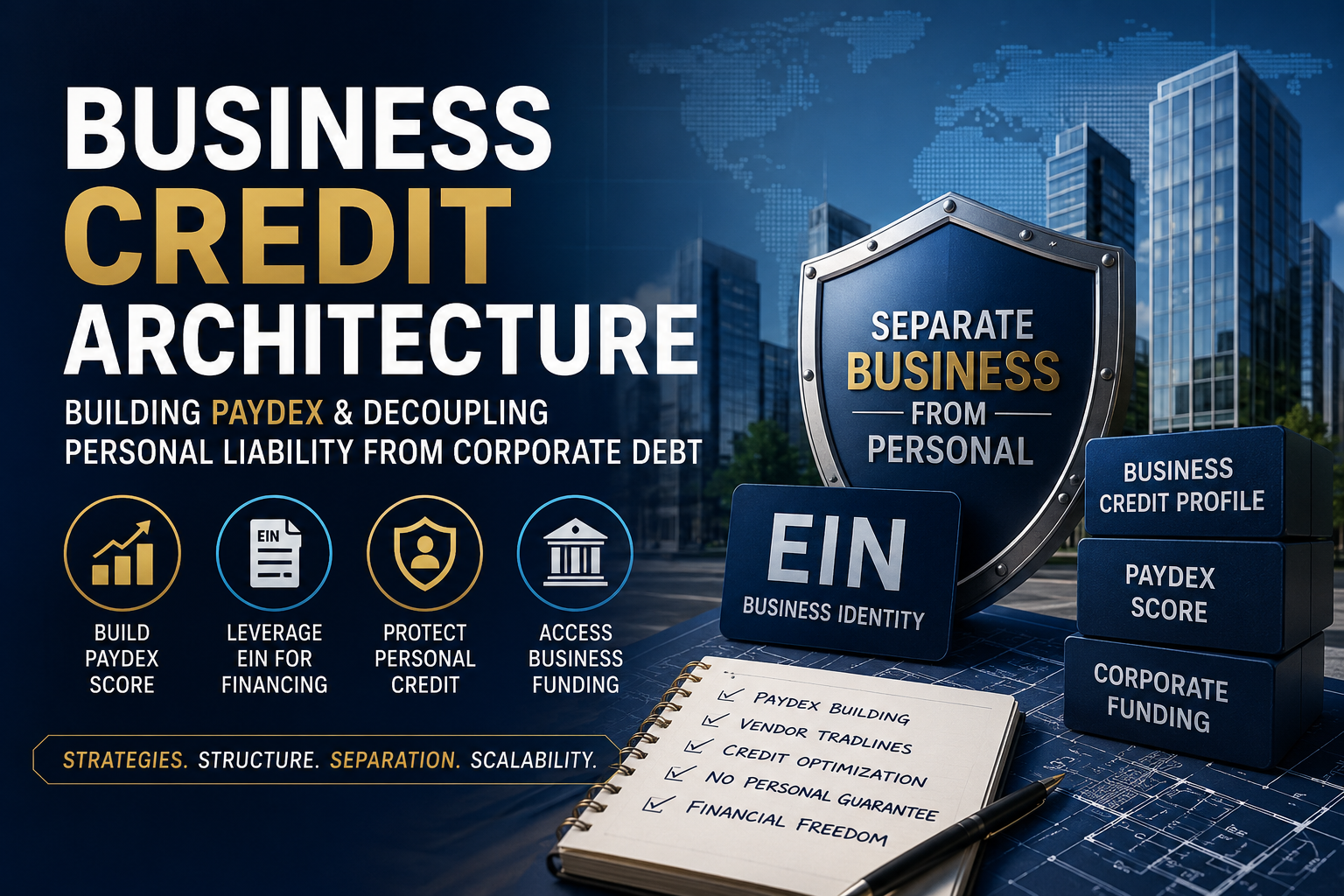
Modern entrepreneurs and advanced financial operators are increasingly shifting toward Business Credit Architecture strategies to build scalable financing systems without damaging personal credit utilization.
- How to build a strong PAYDEX score
- How EIN financing works in 2026
- How to reduce dependency on personal guarantees
- Advanced tradeline sequencing strategies
- Commercial credit optimization frameworks
- How lenders evaluate business credit today
Introduction: Why Business Credit Architecture Matters
Commercial lending has evolved dramatically over the last few years. Traditional underwriting systems relied heavily on personal credit scores, manual reviews, and historical financial statements. Today, lenders increasingly use AI-driven underwriting systems that analyze behavioral payment data, cash-flow stability, and operational consistency.
This transformation has created a significant opportunity for sophisticated business owners who understand how to structure commercial credit properly.
A well-designed Business Credit Architecture framework allows businesses to:
- Access larger funding opportunities
- Reduce personal liability exposure
- Protect personal credit utilization
- Improve liquidity management
- Scale financing capacity efficiently
- Increase lender confidence
At the center of this system is the PAYDEX score, issued by Dun & Bradstreet. Unlike consumer FICO scoring models, PAYDEX focuses heavily on payment timing behavior.
Prerequisites and Environment Setup
Before building a business credit system, foundational infrastructure must be configured correctly.
Required Business Setup
- Registered LLC, Corporation, or LTD
- Employer Identification Number (EIN)
- Business bank account
- Professional domain email
- Business phone listing
- DUNS registration
- Consistent business address records
Commercial Identity Stack
Business Layer:
- LLC or Corporation
- EIN
- Operating Agreement

Credit Layer:
- DUNS Number
- Experian Business
- Equifax Commercial

Banking Layer:
- Business checking account
- Merchant processing
- Treasury management
One of the biggest underwriting issues in 2026 is inconsistent entity data across databases. Modern lenders use automated identity verification systems powered by machine learning.
Even small differences in:
- Business naming formats
- Address formatting
- Phone numbers
- NAICS classifications
- Business start dates
can reduce approval probability.
Step 1: Building PAYDEX with Strategic Vendor Tradelines
The first stage of Business Credit Architecture involves creating reporting tradelines that establish commercial payment history.
Understanding PAYDEX Scores
| PAYDEX Score | Meaning |
|---|---|
| 80+ | Payments made on time |
| 90+ | Payments made early |
| 100 | Payments made significantly early |
Unlike consumer credit models, early payments can dramatically improve PAYDEX performance.
Vendor Sequencing Framework
Phase 1: Foundation Vendors
Recommended Vendors:
- Office supplies
- Packaging vendors
- Shipping companies
- Industrial suppliers
- Business services
Target Goals:
- 3-5 active reporting accounts
- Net-30 payment terms
- Small recurring purchases
- Payments 10-20 days early
Phase 2: Expansion Tradelines
Expansion Categories:
- Fleet accounts
- Telecom vendors
- SaaS providers
- Technology vendors
- Warehouse suppliers
- 8-12 total tradelines
- Diverse account types
- Consistent invoice activity
- Higher transaction volume
Phase 3: Revolving Commercial Credit
Advanced Products:
- Business credit cards
- Corporate charge accounts
- Revenue financing
- Equipment leasing
Many businesses fail because they open too many low-quality tradelines too quickly. Modern underwriting systems identify unnatural account growth patterns.
Step 2: EIN Financing Without Personal Utilization Impact
The second stage of Business Credit Architecture focuses on obtaining financing through the EIN while minimizing personal credit exposure.
Modern Personal Guarantee Structures
| Guarantee Type | Risk Level |
|---|---|
| Full Personal Guarantee | High |
| Limited Guarantee | Moderate |
| Performance Guarantee | Conditional |
| Entity-Only Underwriting | Low |
Funding Progression Strategy
Stage 1: Vendor Financing
- Net-30 vendors
- Trade suppliers
- Operational purchasing accounts
Stage 2: Fleet and Store Credit
- Fuel accounts
- Retail business cards
- Commercial store accounts
Stage 3: Institutional Credit
- Business credit cards
- Working capital lines
- Commercial charge cards
Preventing Personal Credit Leakage
Some business lenders still report activity to consumer bureaus under:
- Default conditions
- Delinquency triggers
- Hybrid underwriting models
Advanced operators increasingly prioritize lenders that separate business reporting from personal utilization metrics.
Cash-Flow Underwriting Trends
Modern lenders increasingly analyze:
- Daily banking balances
- Revenue consistency
- Payroll patterns
- Merchant processing activity
- Subscription liabilities
Strong operational cash flow can sometimes outperform even strong bureau scores.
Step 3: Advanced Business Credit Optimization
Once foundational systems are established, advanced optimization strategies become possible.
Commercial Utilization Targets
| Credit Product | Recommended Utilization |
|---|---|
| Business Revolving Cards | 10-20% |
| Fleet Accounts | 20-30% |
| Business LOCs | Below 35% |
Behavioral Risk Scoring
AI underwriting systems increasingly evaluate:
- Sudden spending spikes
- Rapid tradeline growth
- Irregular payment patterns
- Abnormal purchasing behavior
Optimization must appear operationally natural.
UCC Filing Management
Excessive UCC filings can negatively affect financing approvals because lenders may view them as:
- Overleveraging signals
- Collateral exhaustion
- Liquidity pressure indicators
Strategic UCC cleanup can improve institutional lending outcomes significantly.
Advanced Multi-Entity Structures
Entity A:
Operations company

Entity B:
IP holding company

Entity C:
Equipment subsidiary

Entity D:
Financing SPV
While advanced structures improve risk segmentation, they also increase:
- Legal complexity
- Tax planning requirements
- Compliance overhead
- Accounting obligations
Lead Magnets for Conversion Optimization
High-performing business credit content converts best when paired with implementation-focused lead magnets.
Recommended Lead Magnets
- PAYDEX Optimization Checklist
- Business Credit Vendor Database
- No-PG Lender Matrix
- Commercial Bureau Audit Template
- EIN Financing Tracker
- Business Credit Architecture Blueprint
Social Proof Integration Examples
“After restructuring our vendor sequencing strategy, our PAYDEX score increased from 63 to 90 in seven months.”
“Moving operational expenses onto EIN-based revolving accounts reduced personal utilization by 42%.”
Common Issues and Troubleshooting
PAYDEX Score Not Appearing
Possible Causes:
- Too few reporting vendors
- Inactive DUNS profile
- Vendors not reporting regularly
Solutions:
- Maintain at least 3 active tradelines
- Confirm vendor reporting cycles
- Pay invoices early consistently
Business Card Reporting to Personal Credit
Solutions:
- Research issuer reporting policies
- Avoid high utilization on hybrid accounts
- Transition toward entity-only lenders
Financing Denials Despite Strong PAYDEX
Possible Causes:
- Weak cash flow
- Excessive UCC filings
- Inconsistent business records
Solutions:
- Improve banking consistency
- Reduce debt concentration
- Audit commercial bureau records
Future Trends in Commercial Credit
Commercial underwriting is rapidly evolving toward AI-driven operational analysis.
Emerging trends include:
- Real-time cash-flow underwriting
- Behavioral payment analytics
- Open banking integrations
- Predictive liquidity modeling
- Embedded finance ecosystems
Businesses that build strong operational credibility today will maintain significant financing advantages in the future.
Conclusion
Business Credit Architecture is no longer simply about obtaining vendor accounts or increasing PAYDEX scores. The real objective is building a scalable commercial financing ecosystem that minimizes personal liability exposure while improving access to institutional capital.
By combining strategic tradeline sequencing, intelligent EIN financing, operational consistency, and advanced commercial credit optimization, businesses can unlock substantially stronger funding opportunities.
The businesses that treat Business Credit Architecture as long-term infrastructure rather than short-term financing will be positioned to scale more efficiently, negotiate stronger terms, and maintain greater resilience during economic uncertainty.
Download the Advanced Business Credit Toolkit
Get access to:
- PAYDEX optimization systems
- Vendor reporting databases
- No-PG lender lists
- Commercial funding frameworks
- EIN financing strategies
Start building institutional-grade business credit systems today.