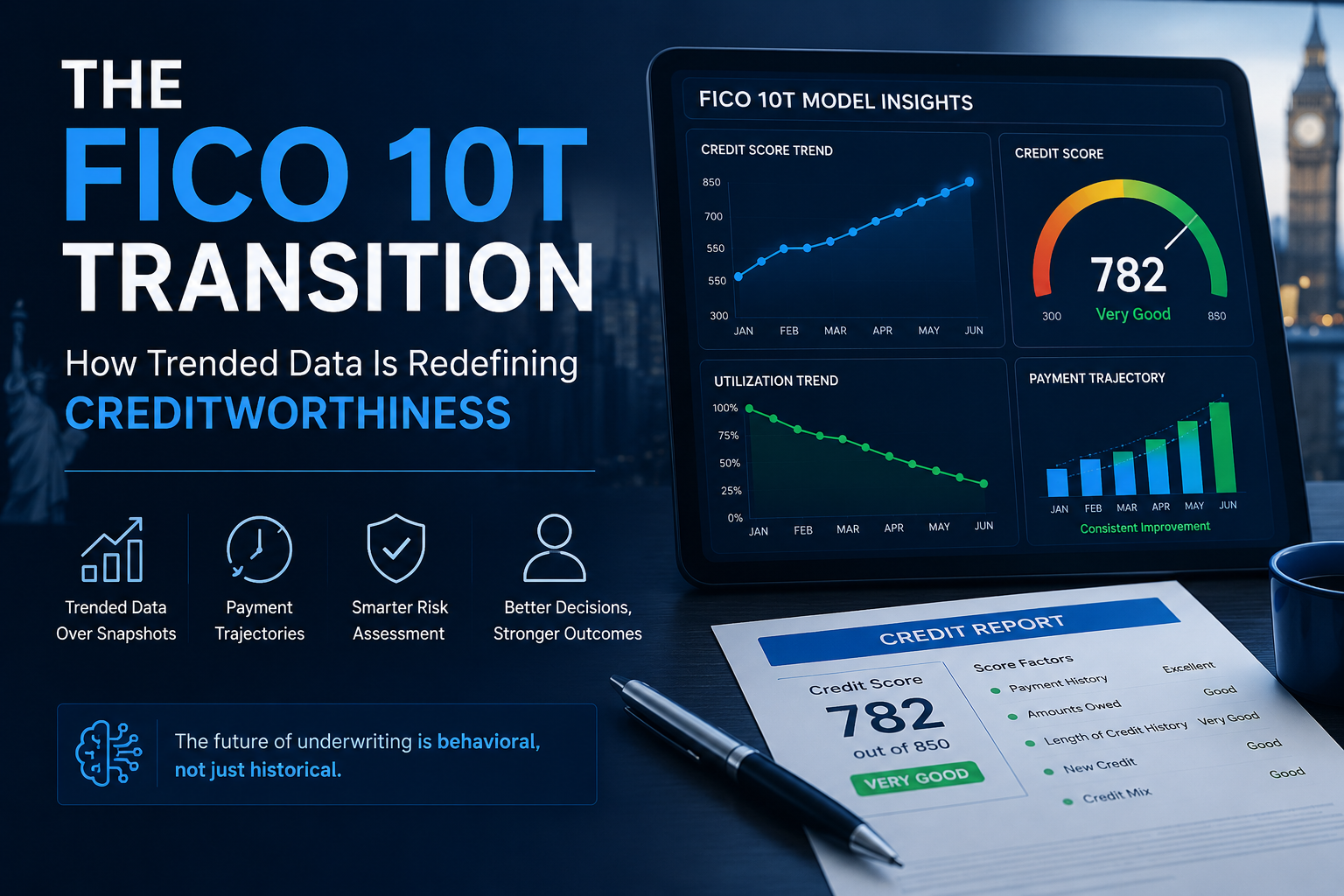
The FICO 10T Transition is reshaping the lending industry by moving beyond static credit snapshots and focusing on trended behavioral data. Modern lenders in the USA and UK now analyze historical payment trajectories, utilization trends, and borrowing behavior to assess true creditworthiness.
Introduction
Traditional credit scoring systems evaluated borrowers using point-in-time data. However, that approach often failed to identify behavioral risk patterns. A borrower with 30% utilization today may appear financially stable, but if their debt has steadily increased over the past 12 months, lenders now interpret that as a warning signal.
This shift is why the FICO 10T Transition matters. Modern underwriting systems now focus heavily on repayment direction, balance migration, and behavioral consistency.
Why This Matters
- Mortgage approvals are becoming more behavior-driven
- Fintech underwriting models rely on historical trajectories
- Credit card issuers now track utilization velocity
- Buy Now Pay Later data is increasingly integrated into risk models
Prerequisites and Environment Setup
Before implementing advanced trended-data strategies, professionals should understand:
- Traditional FICO scoring systems
- Debt-to-income calculations
- Revolving utilization analytics
- Basic predictive modeling
- Consumer credit reporting frameworks
import pandas as pd
import numpy as np
from sklearn.linear_model import LogisticRegression
Step 1: Build a Trended Utilization Analysis Framework
The first major transformation in the FICO 10T Transition involves utilization trajectory analysis.
Older scoring models only measured current utilization percentages. Newer underwriting systems evaluate whether utilization is improving or deteriorating over time.
Understanding Utilization Velocity
| Month | Credit Utilization |
|---|---|
| January | 82% |
| February | 74% |
| March | 66% |
| April | 58% |
| May | 46% |
This borrower demonstrates positive deleveraging behavior. Under modern underwriting systems, this trajectory may outperform a borrower with stable but gradually increasing debt.
Technical Example
def utilization_velocity(data):
    changes = []

    for i in range(1, len(data)):
        changes.append(data[i] - data[i-1])

    return np.mean(changes)

trajectory = [82,74,66,58,46]

print(utilization_velocity(trajectory))
Step 2: Analyze Payment Trajectories Instead of Payment Status
One of the biggest innovations in the FICO 10T Transition is the shift from binary payment evaluation to behavioral repayment analysis.
Traditional systems only checked whether payments were late. Modern systems analyze:
- Minimum payment dependency
- Payment-to-balance ratios
- Consistency of principal reduction
- Debt stabilization patterns
High-Risk Behavioral Indicators
- Consistent minimum-only payments
- Rapid revolving balance growth
- Increasing utilization despite regular payments
- Frequent BNPL borrowing cycles
Low-Risk Behavioral Indicators
- Stable monthly repayments
- Gradual balance reduction
- Predictable utilization trends
- Controlled credit exposure
Predictive Modeling Example
features = [
    "utilization_trend",
    "payment_ratio",
    "balance_growth",
    "delinquency_history"
]

X = dataset[features]
y = dataset["default"]

model = LogisticRegression()

model.fit(X, y)
Step 3: Optimize Credit Profiles for Modern Underwriting
Consumers and advisors who still optimize for outdated scoring models risk underperforming in modern lending environments.
Strategic Deleveraging
Advanced credit optimization now focuses on:
- Controlled utilization reduction
- Stable repayment patterns
- Low volatility in revolving balances
- Long-term behavioral consistency
Advanced Optimization Phases
Phase 1: Stabilization
- Stop utilization growth
- Eliminate missed payments
- Normalize payment timing
Phase 2: Controlled Deleveraging
- Reduce balances gradually
- Maintain stable utilization patterns
- Increase repayment ratios
Phase 3: Behavioral Reinforcement
- Improve credit mix diversity
- Maintain low utilization volatility
- Strengthen repayment consistency
Recent Developments in the FICO 10T Transition
Buy Now Pay Later Integration
BNPL platforms are increasingly reporting consumer repayment behavior to credit ecosystems. Lenders now evaluate:
- Installment stacking
- Short-term borrowing frequency
- Behavioral dependence patterns
AI-Powered Underwriting Systems
Modern fintech lenders are integrating:
- Cash flow analysis
- Open banking data
- Income stability forecasting
- Behavioral spending analytics
Mortgage Lending Evolution
Mortgage lenders now prioritize:
- Long-term repayment stability
- Decreasing utilization trends
- Reserve accumulation behavior
- Behavioral consistency during economic volatility
Tradeoffs and Limitations
Privacy Concerns
Behavioral underwriting models create concerns about:
- Financial surveillance
- Algorithmic opacity
- Behavior-based discrimination
Economic Sensitivity
Trended models may overreact during:
- Recessions
- Inflationary periods
- Temporary income disruptions
Academic Research Supporting Trended Data
Multiple studies from financial institutions and research journals indicate that behavioral repayment trends outperform static utilization snapshots in predicting future delinquency risk.
- Federal Reserve utilization migration studies
- Fair Isaac behavioral scoring research
- Journal of Banking & Finance repayment trajectory models
Common Issues and Troubleshooting
Problem: Credit Score Drops During Debt Payoff
Cause: Abrupt utilization changes or account closures.
Solution: Reduce balances gradually while maintaining account age stability.
Problem: Strong Income But Weak Approvals
Cause: Increasing revolving debt trajectory.
Solution: Focus on lowering utilization velocity.
Problem: BNPL Usage Hurting Loan Approvals
Cause: Excessive installment stacking patterns.
Solution: Reduce short-term financing dependence.
Lead Magnet Opportunities
1. Trended Credit Optimization Checklist
- Utilization tracking framework
- Payment ratio benchmarks
- Behavioral risk indicators
2. FICO 10T Monitoring Spreadsheet
- Track utilization velocity
- Monitor repayment trends
- Analyze behavioral consistency
3. Underwriting Risk Calculator
- Estimate approval probability
- Identify behavioral risk signals
- Forecast utilization trends
Social Proof Integration
“One borrower reduced utilization from 91% to 38% over 14 months and improved mortgage eligibility despite only modest traditional score improvement.”
Data-backed case studies significantly improve trust and conversion rates for financial education websites.
Conclusion
The FICO 10T Transition represents one of the most important changes in modern underwriting. Static credit snapshots are rapidly losing importance as lenders prioritize behavioral analytics, repayment consistency, and utilization trajectories.
Professionals who understand trended data modeling, payment trajectory analysis, and behavioral credit optimization will gain a major advantage in the evolving credit ecosystem across the USA and UK markets.
The future of underwriting is no longer about where borrowers stand today. It is about the direction they are moving tomorrow.