AI-driven credit scoring is redefining lending decisions in 2026. Modern machine learning models now evaluate real-time behavioral signals, open banking data, BNPL repayment history, and transaction intelligence to determine approval odds with far greater precision than traditional credit scoring systems.
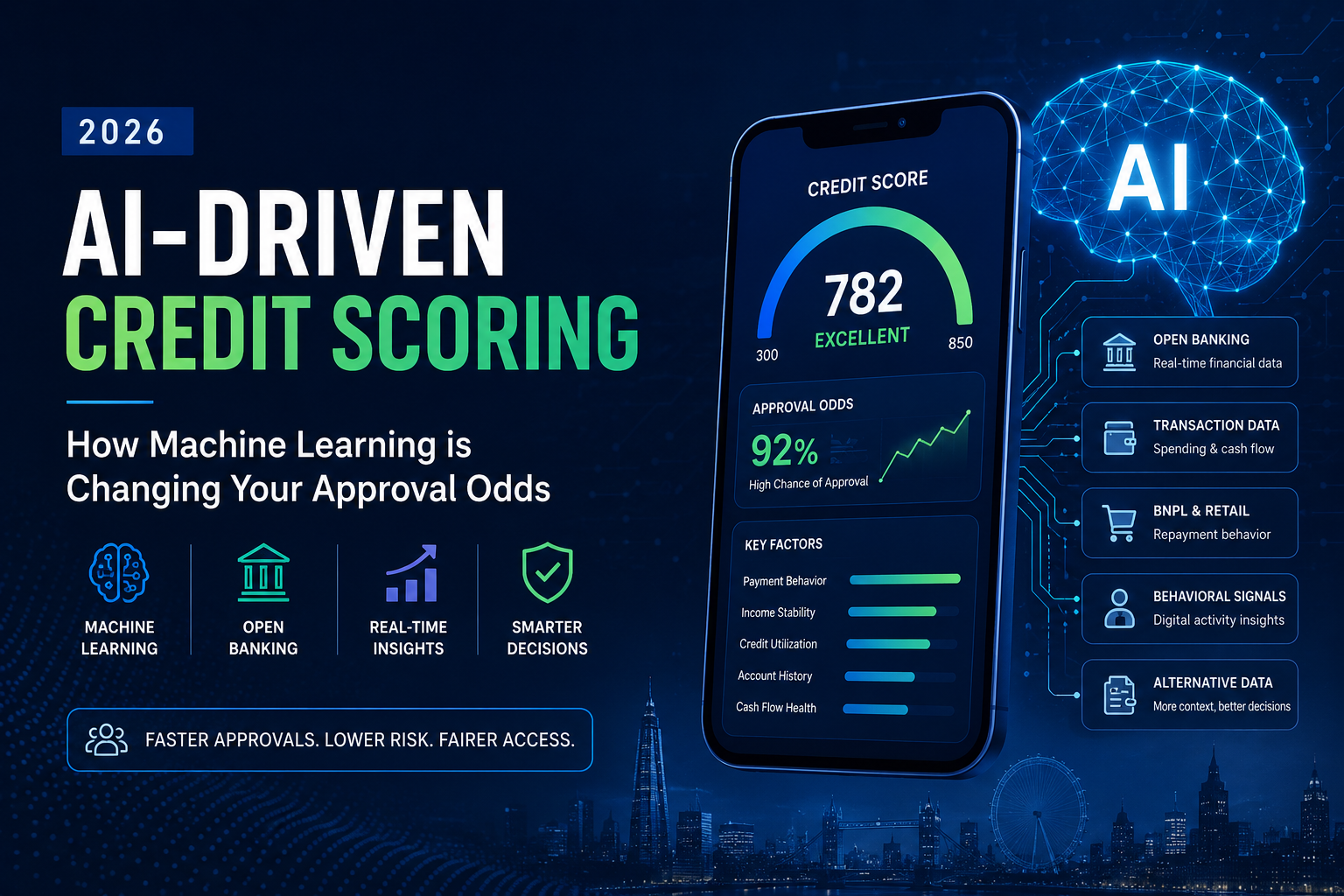
AI-Driven Credit Scoring in 2026: How Machine Learning Is Changing Your Approval Odds
Introduction
Traditional lending systems were built for a slower financial world. Static scoring models based heavily on payment history and utilization rates can no longer accurately assess today’s digital consumers.
In 2026, AI-driven credit scoring systems use machine learning to evaluate thousands of behavioral and financial signals in real time. This shift is changing how borrowers are approved across the USA and UK.
Consumers who were previously rejected due to thin credit files or unconventional income streams can now qualify through alternative data analysis. At the same time, lenders are improving fraud detection, reducing defaults, and optimizing portfolio profitability.
Why This Matters
- Approval decisions happen faster
- Alternative data improves borrower access
- Real-time underwriting reduces risk
- AI models personalize loan pricing
- Open banking transforms risk assessment
Prerequisites and Environment Setup
Advanced practitioners working with AI-driven credit scoring systems should be familiar with:
- Python
- Machine learning pipelines
- Feature engineering
- Financial risk modeling
- Regulatory compliance frameworks
- Cloud deployment infrastructure
pip install pandas numpy scikit-learn xgboost lightgbm shap fastapiHow AI-Driven Credit Scoring Works in 2026
Modern AI-driven credit scoring systems continuously analyze financial activity instead of relying solely on static historical records.
Machine learning models evaluate:
- Income consistency
- Cash-flow behavior
- Merchant transaction patterns
- Subscription liabilities
- BNPL repayment activity
- Digital wallet usage
- Fraud risk indicators
- Behavioral financial signals
Step 1: Data Collection and Feature Engineering
Feature engineering remains one of the strongest competitive advantages in AI-driven credit scoring.
High-performing models combine traditional bureau data with alternative behavioral signals.
Core Data Sources
- Credit bureau history
- Open banking APIs
- Payroll systems
- BNPL repayment records
- Utility payment data
- Rental payment history
- Behavioral session analytics
Feature Engineering Example
import pandas as pd

df["income_stability_score"] = (
    df["monthly_income_std"] /
    df["average_monthly_income"]
)

df["cashflow_health"] = (
    df["monthly_inflow"] -
    df["monthly_outflow"]
)

df["spending_entropy"] = (
    df["merchant_diversity"] /
    df["transaction_volume"]
)
In 2026, sophisticated feature engineering often delivers better gains than increasing model complexity.
Step 2: Model Selection and Training
The most effective AI-driven credit scoring models depend on the specific underwriting objectives.
Gradient Boosting Models
Gradient boosting remains dominant because it balances predictive power with explainability.
from lightgbm import LGBMClassifier

model = LGBMClassifier(
    num_leaves=64,
    learning_rate=0.03,
    n_estimators=1000
)

model.fit(X_train, y_train)
Benefits
- Fast inference speed
- Strong tabular data performance
- Lower infrastructure cost
- Regulatory compatibility
Deep Learning Systems
Neural networks are increasingly used for behavioral risk modeling and transaction-sequence analysis.
from tensorflow.keras.models import Sequential
from tensorflow.keras.layers import LSTM, Dense

model = Sequential([
    LSTM(128, input_shape=(30, 20)),
    Dense(64, activation='relu'),
    Dense(1, activation='sigmoid')
])| Advantage | Tradeoff |
|---|---|
| Better sequence analysis | Reduced interpretability |
| Higher personalization | Higher infrastructure cost |
| Improved fraud detection | Regulatory complexity |
Step 3: Explainable AI and Real-Time Deployment
Explainability is now mandatory in AI-driven credit scoring systems across regulated lending markets.
Regulators increasingly require lenders to justify automated decisions using transparent model interpretation techniques.
SHAP Explainability Example
import shap

explainer = shap.TreeExplainer(model)
shap_values = explainer.shap_values(X_test)

shap.summary_plot(shap_values, X_test)
Real-Time Lending API Example
from fastapi import FastAPI
import joblib

app = FastAPI()

model = joblib.load("credit_model.pkl")

@app.post("/predict")
def predict(features: dict):
    prediction = model.predict([list(features.values())])

    return {
        "approval_probability": float(prediction[0])
    }
Many fintech lenders now target approval decisions in under 200 milliseconds.
Open Banking and Alternative Data
Open banking has become a critical part of AI-driven credit scoring in both the USA and UK.
Instead of relying entirely on bureau history, lenders can now evaluate:
- Salary deposits
- Cash reserves
- Recurring expenses
- Subscription obligations
- Savings consistency
- Income volatility
This particularly benefits freelancers, gig workers, and thin-file borrowers.
How BNPL Data Is Changing Approval Odds
Buy Now Pay Later repayment activity now plays a major role in AI-driven credit scoring models.
Key BNPL indicators include:
- Installment completion rate
- Payment timing consistency
- Deferred payment stacking
- Refund frequency
- Merchant category exposure
Some lenders now prioritize BNPL consistency more heavily than credit card utilization for younger consumers.
Advanced Risk Modeling Techniques
Graph Neural Networks
Graph-based systems help lenders identify fraud networks and connected borrower risks.
- Shared devices
- IP relationships
- Identity linkage
- Transaction clusters
Federated Learning
Privacy-focused architectures allow institutions to collaborate without directly sharing sensitive borrower data.
| Benefit | Challenge |
|---|---|
| Improved privacy | Higher infrastructure complexity |
| Regulatory alignment | Slower convergence |
| Collaborative intelligence | Synchronization overhead |
Bias and Regulatory Challenges
AI-driven credit scoring systems can unintentionally create bias through proxy variables linked to income, geography, or device quality.
Modern compliance frameworks require:
- Fairness monitoring
- Demographic parity testing
- Explainability systems
- Bias auditing
- Human oversight
from fairlearn.metrics import demographic_parity_difference

difference = demographic_parity_difference(
    y_true,
    y_pred,
    sensitive_features=group_labels
)

print(difference)
Lead Magnet Opportunities for Finance Brands
High-Converting Lead Magnets
- AI Approval Odds Calculator
- Open Banking Credit Audit
- BNPL Risk Exposure Analyzer
- Real-Time Credit Optimization Tracker
- 2026 AI Lending Readiness Checklist
These tools perform exceptionally well because they provide immediate personalized value while increasing engagement and conversion rates.
Common Issues and Troubleshooting
1. Model Overfitting
Symptoms:
- High training accuracy
- Poor production performance
- Prediction instability
Solution:
model = XGBClassifier(
    max_depth=4,
    reg_alpha=0.5,
    reg_lambda=1.0
)
2. Data Drift
Symptoms:
- Approval inconsistencies
- Rising default rates
- Feature instability
Solution:
- Continuous monitoring
- Population stability analysis
- Automated retraining pipelines
3. Bias Amplification
Solution:
- Fairness-aware training
- Explainability systems
- Human review layers
4. Latency Bottlenecks
Solution:
- Feature caching
- Model compression
- Optimized APIs
- Scalable cloud infrastructure
The Future of AI-Driven Credit Scoring
The future of lending will increasingly rely on continuous underwriting systems powered by behavioral intelligence.
Expected developments include:
- Autonomous lending agents
- Portable financial identity scores
- Behavioral financial twins
- Continuous real-time risk evaluation
- Transformer-based transaction intelligence
Conclusion
AI-driven credit scoring is transforming how lenders evaluate risk and determine approval odds in 2026. Machine learning systems now process behavioral data, real-time financial activity, BNPL usage, and open banking signals far beyond traditional bureau-centric models.
For lenders, this creates opportunities to improve fraud detection, reduce defaults, and increase approval precision. For consumers, approval outcomes increasingly depend on financial behavior patterns rather than static credit history alone.
However, the rise of AI-driven credit scoring also introduces serious challenges involving fairness, explainability, governance, compliance, and infrastructure scalability.
Organizations that successfully combine predictive accuracy with regulatory transparency will define the next generation of financial underwriting systems.