
Table of Contents
Introduction
Three digits. That’s all it takes to shape whether a mortgage gets approved, what interest rate a lender offers, or even whether a landlord hands over the keys to an apartment. Credit scores are among the most consequential numbers in American financial life, yet the mechanics behind them remain poorly understood by a large portion of the population.
This article takes a deep, factual look at how credit scores are actually calculated in the United States — the models used, the specific factors that drive those models, how different bureaus come into play, and what the key differences are between the two dominant scoring systems. No shortcuts, no fluff.
What Is a Credit Score?
A credit score is a three-digit numerical representation of a person’s creditworthiness — essentially a statistical estimate of the likelihood that someone will repay their debts as agreed. Scores in the US typically fall on a scale of 300 to 850, with higher numbers indicating lower perceived risk to lenders.
Critically, a credit score is not generated by hand. It is produced by a scoring model — a mathematical algorithm — applied to the data contained in a person’s credit report. The credit report itself is maintained by one of the three major consumer reporting agencies: Equifax, Experian, and TransUnion.
The Consumer Financial Protection Bureau (CFPB) describes credit scores as tools lenders use to quickly assess credit risk. These scores influence approvals for credit cards, auto loans, mortgages, and personal loans, and in many cases affect the interest rate a borrower is offered. Some insurers in states that allow it also use credit-based insurance scores, and certain employers may review credit reports as part of background checks.
The Two Dominant Scoring Models in the US
While dozens of credit scoring models exist in the marketplace, two companies dominate the space in the United States:
FICO® Scores
The FICO Score was developed by Fair Isaac Corporation. FICO became the first company to create credit scoring models based on consumer credit reports in 1989. Today, FICO says it is used by 90% of “top lenders.” The most widely used version for everyday lending decisions is FICO Score 8, though FICO 9, FICO 10, and industry-specific versions (for auto lending and credit cards) also exist. Base FICO® Scores range from 300 to 850 and are created for any type of lender. They attempt to predict the likelihood that a consumer will fall behind on any type of credit obligation.
VantageScore®
VantageScore was introduced in 2006 by the three major credit bureaus — Experian, Equifax, and TransUnion — designed to offer a more uniform scoring system across all three agencies. The current widely-used versions are VantageScore 3.0 and VantageScore 4.0. VantageScore 4.0 relies on advanced machine learning and trending data to enhance risk assessment. As of July 2025, it is approved for Fannie Mae and Freddie Mac mortgage loans. A newer model, VantageScore 5.0, was released in April 2025, leveraging 24 months of trended data to significantly enhance risk prediction.
Both models use the 300–850 scale, but they differ meaningfully in how they weigh individual factors — which is explored in detail below.
How FICO Scores Are Calculated
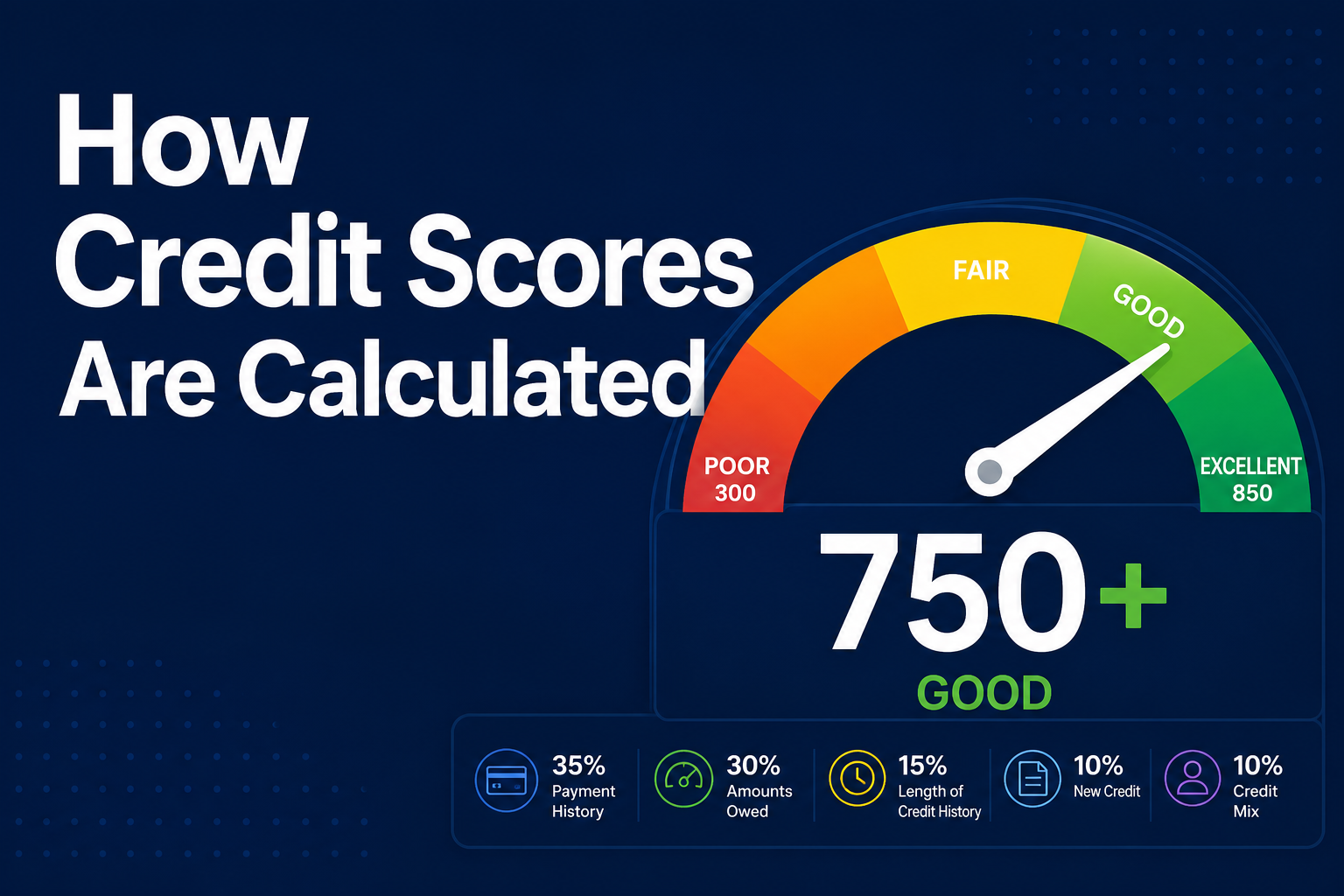
While FICO doesn’t reveal its exact scoring formula, it provides useful guidelines about the factors that matter for scores. There are five primary categories, each assigned a specific percentage weight:
| Factor | Weight |
|---|---|
| Payment History | 35% |
| Amounts Owed (Credit Utilization) | 30% |
| Length of Credit History | 15% |
| New Credit | 10% |
| Credit Mix | 10% |
1. Payment History — 35%
This is the single largest factor in the FICO Score calculation. Credit scoring systems analyze credit reports to evaluate how you manage credit, focusing on factors such as your payment history, total debt, usage of available credit, length of credit history, credit mix, and new credit. Payment history covers whether accounts were paid on time across all credit types — credit cards, installment loans, retail accounts, mortgages, and more.
Payment history represents approximately 35% of a FICO® Score and is based on payment information across many types of accounts, including credit cards, retail accounts, installment loans, and finance company accounts.
Negative events in this category include:
- Late payments (30, 60, 90 days past due)
- Collections accounts
- Charge-offs
- Bankruptcies
- Foreclosures
The severity of the impact depends on how late the payment was, how recently it occurred, and how many times it happened. A single 30-day late payment on an otherwise clean history has a very different effect than a pattern of missed payments across multiple accounts.
2. Amounts Owed (Credit Utilization) — 30%
Amounts owed are responsible for 30% of a FICO® Score. The credit utilization ratio — the percentage of borrowing limit used on revolving accounts — is a significant factor in this category.
Credit utilization is not just calculated on a per-card basis. FICO considers both:
- Individual card utilization (balance ÷ limit on each card)
- Overall utilization (total balances ÷ total credit limits)
Maintaining a high amount of debt on credit cards, or maxing them out, signals risky and unstable financial behavior according to the FICO rating system. Beyond utilization, this category also looks at the total dollar amount of debt owed, how much is owed on installment loans relative to the original balances, and how many accounts carry a balance.
3. Length of Credit History — 15%
This refers to how long a person has had credit and the average age of their credit accounts. FICO specifically considers:
- The age of the oldest account
- The age of the most recently opened account
- The average age of all accounts
- How long specific account types have been open
- How recently each account was used
A longer, well-managed credit history generally favors a higher score. This is why long-held accounts, even inactive ones, often carry value for the overall credit profile.
4. New Credit — 10%
Opening up new credit may affect the FICO Score as it usually results in an inquiry posting and a newly open credit account being reported. This impacts the length of credit history (15%), search for new credit (10%), and credit mix (10%) categories of the FICO Score.
When a lender pulls a credit report as part of an application decision, that generates a hard inquiry. In general, credit inquiries have a small impact on FICO® Scores. For most people, one additional credit inquiry will take less than five points off their FICO Scores.
One important feature within this category is the rate-shopping window. For recent versions of the FICO Score, numerous hard inquiries of the same type — student, auto, or mortgage loans — within a 45-day window are counted as a single inquiry. For older versions of the FICO Score, this rate-shopping window is a 14-day span.
5. Credit Mix — 10%
Credit mix is one of the five main FICO score factors and accounts for about 10% of the consumer FICO score. It refers to the variety of credit accounts listed on credit reports.
A diverse mix typically includes a combination of revolving accounts (credit cards, lines of credit) and installment accounts (auto loans, mortgages, student loans, personal loans). FICO recognizes that people who can responsibly manage multiple types of credit may represent a different risk profile than those with only one account type.
This is one of the least weighted factors, and it does not mean that individuals need to take on unnecessary debt just to diversify their credit mix.
How VantageScore Is Calculated
VantageScore uses a similar set of underlying data but organizes and weighs it differently. VantageScore does not publish exact percentage weights the way FICO does, but it ranks factors by influence:
| Factor | Influence Level |
|---|---|
| Payment History | Extremely Influential |
| Depth of Credit (Age + Mix) | Highly Influential |
| Credit Utilization | Highly Influential |
| Balances | Moderately Influential |
| Recent Credit (Inquiries + New Accounts) | Less Influential |
| Available Credit | Less Influential |
One notable structural difference: VantageScore combines what FICO separates into “length of credit history” and “credit mix” into a single category called Depth of Credit. This reflects how VantageScore views these two dimensions as closely related measures of credit depth.
Trended Data: A Key Differentiator in VantageScore 4.0
VantageScore 4.0 considers trended credit data, which means it looks at how balances change over time instead of focusing on a balance at a single moment.
Older models only saw a current balance. Trended data sees how balances have changed over the past 24 months. A consumer who carries a consistent $4,000 balance month after month is evaluated differently from someone who pays the same total down to a much lower amount each cycle, even if their snapshot balance looks the same.
This distinction can affect how the model interprets identical-looking credit reports differently based on the direction of debt — whether balances are trending down, holding steady, or increasing.
Hard vs. Soft Inquiries: What Actually Hurts Your Score
One of the most commonly misunderstood aspects of credit scoring is the distinction between hard and soft inquiries.
Hard Inquiries occur when a lender or creditor reviews a credit report in connection with a credit application. According to FICO, hard inquiries may lower credit scores by about five points. Hard inquiries can stay on credit reports for up to two years, but FICO only looks at inquiries from the most recent year.
Soft Inquiries include things like checking your own credit score, pre-qualification checks by lenders, and background checks. Soft inquiries such as viewing your own credit report will not affect FICO® Scores.
Statistically, people with six or more inquiries on their credit reports can be up to eight times more likely to declare bankruptcy than people with no inquiries on their reports. This is why scoring models flag clusters of hard inquiries — they can signal financial stress or aggressive credit-seeking behavior.
FICO vs. VantageScore: A Side-by-Side Comparison
| Feature | FICO Score | VantageScore 4.0 |
|---|---|---|
| Created By | Fair Isaac Corporation | Experian, Equifax, TransUnion (jointly) |
| Year Introduced | 1989 | 2006 |
| Score Range | 300–850 | 300–850 |
| Minimum Credit History Required | 6 months of activity | 1 month of activity |
| Weighting Published? | Yes (publicly stated percentages) | No (influence tiers, not percentages) |
| Trended Data Used? | Not in FICO 8/9 (FICO 10T does) | Yes, in 4.0 |
| Paid Collections Treatment | FICO 9: Ignored. FICO 8: Still counted. | Ignored (weighted less for medical) |
| Rate-Shopping Window | 45 days (newer versions) | 14 days |
| Mortgage Eligibility | Standard for Fannie/Freddie (historical) | Approved for Fannie/Freddie as of July 2025 |
| Lender Usage | ~90% of top lenders | Growing; common in free monitoring tools |
VantageScore weighs credit utilization at 20%, while FICO weighs credit utilization at 30%. Similarly, payment history accounts for 35% of a FICO score and 40% of a VantageScore.
Where Credit Score Data Comes From
No scoring model generates data on its own. Every score is only as accurate as the credit report it is applied to. Those reports are maintained separately by the three major credit bureaus — Equifax, Experian, and TransUnion.
Each bureau collects information from furnishers — lenders, credit card issuers, collection agencies, and other financial institutions — who voluntarily report account data. Critically, not all creditors report to all three bureaus, and there is no legal requirement to report to any bureau at all. This means an auto lender might report only to TransUnion, while a credit card issuer might report to all three.
The practical result: the data in a person’s Equifax file, Experian file, and TransUnion file can differ. And because scores are calculated from those individual files, a FICO Score from Equifax may differ from a FICO Score from Experian — even for the same person on the same day.
This is also why consumers are encouraged to review all three reports rather than relying on just one. Free annual reports from all three bureaus are available at AnnualCreditReport.gov, as authorized under the Fair Credit Reporting Act (FCRA).
Why Your Score Can Look Different in Different Places
Many consumers are surprised to see that their score varies depending on where they check it. Several factors explain this:
- Different bureaus, different data. As noted above, not all lenders report to all three bureaus.
- Different scoring models. A bank might use FICO 8, while a free monitoring app shows a VantageScore 3.0. These are mathematically distinct models.
- Timing. Scores are calculated at the moment the report is pulled, and account balances change throughout the month. A score pulled after a large payment posts will differ from one pulled the day before.
- Model-specific differences. VantageScore’s model can score approximately 30 to 35 million people who would be considered unscorable by FICO. FICO requires at least six months of credit history and at least one account reported within the last six months.
Understanding Negative Marks and Their Impact
Negative information on a credit report doesn’t stay forever. The Fair Credit Reporting Act (FCRA) governs how long most items remain:
| Item | How Long It Stays on Report |
|---|---|
| Late payments (30+ days) | 7 years from the date of first delinquency |
| Collection accounts | 7 years from original delinquency |
| Chapter 7 Bankruptcy | 10 years from filing date |
| Chapter 13 Bankruptcy | 7 years from filing date |
| Hard inquiries | 2 years (affect FICO score for ~12 months) |
| Civil judgments | 7 years (in most cases) |
The scoring impact of negative marks also diminishes over time. A late payment from six years ago carries far less weight than one from six months ago, even if both remain visible on the report.
Credit Score Ranges at a Glance
Both FICO and VantageScore use the same 300–850 scale, but they define score tiers slightly differently:
| Score Range | FICO Label | VantageScore 4.0 Label |
|---|---|---|
| 800–850 | Exceptional | Excellent |
| 740–799 | Very Good | Good |
| 670–739 | Good | Good |
| 580–669 | Fair | Fair |
| 300–579 | Poor | Very Poor |
The Current State of US Credit Scores
As of early 2025, the national average FICO Score stands at 715, reflecting a drop partly due to recent reporting of federal student loan delinquencies on credit files for the first time since March 2020.
Key findings from FICO’s fall 2025 Credit Insights Report noted that the national average FICO Score dipped two points from 2024, driven by rising credit card utilization and a spike in missed payments. Gen Z consumers (ages 18–29) experienced the largest average FICO® Score decrease of any age group, down three points year-over-year, and showed a higher rate of large score swings compared to the national average.
Meanwhile, the average VantageScore 4.0 credit score rose to 701 as of February 2026, driven by improved balance-to-loan ratios among top-tier consumers.
Summary of Key Points
On FICO Scores:
- Created in 1989; used in approximately 90% of top US lending decisions.
- Score range: 300–850.
- Five factors: Payment History (35%), Amounts Owed (30%), Length of Credit History (15%), New Credit (10%), Credit Mix (10%).
- Requires at least six months of credit history with activity in the last six months to generate a score.
- Hard inquiries stay on reports for two years but only affect FICO scores for 12 months.
- Multiple loan-type inquiries within a 45-day window count as a single inquiry in recent versions.
On VantageScore:
- Introduced in 2006 by the three major bureaus jointly.
- Score range: 300–850.
- Uses six factors: Payment History, Depth of Credit, Credit Utilization, Balances, Recent Credit, Available Credit.
- Can generate a score with as little as one month of credit history.
- VantageScore 4.0 uses trended data (24 months of balance history).
- Approved for Fannie Mae/Freddie Mac mortgage use as of July 2025.
On Credit Bureaus:
- Three bureaus: Equifax, Experian, TransUnion.
- Data can differ across bureaus because not all creditors report to all three.
- Scores from the same model can differ across bureaus due to different underlying data.
- Free annual reports available at AnnualCreditReport.gov under the FCRA.
On Inquiries:
- Hard inquiries (from credit applications) can temporarily lower a FICO Score by fewer than five points.
- Soft inquiries (self-checks, pre-qualifications) do not affect scores.
- Rate-shopping protections group same-type loan inquiries within a window into a single hit.
Sources
- FICO — Average U.S. FICO Score Drops to 715 (April 2025): investors.fico.com
- FICO — FICO Score Credit Insights Report, Fall 2025: investors.fico.com
- myFICO — Do Credit Inquiries Lower Your FICO Score?: myfico.com
- myFICO — How Credit Actions Impact FICO Scores: myfico.com
- myFICO — Soft vs. Hard Pull Credit Inquiries: myfico.com
- VantageScore — The Complete Guide to Your VantageScore: vantagescore.com
- Experian — What Affects Your Credit Scores?: experian.com
- Capital One — Hard vs. Soft Inquiry: capitalone.com
- Consumer Financial Protection Bureau (CFPB): consumerfinance.gov
- Chase — VantageScore® vs. FICO® Credit Scores: chase.com
- NerdWallet — FICO Score Meaning: How It Works: nerdwallet.com
- VantageScore CreditGauge — February 2026 Report: businesswire.com
- First Heritage Mortgage — VantageScore 4.0 vs. FICO 10 Differences: fhmtg.com
- CNBC Select — Average Credit Score in the US in 2025: cnbc.com
Disclaimer: This article is published for educational and informational purposes only. The content on CreditPur.com is not financial advice, legal advice, or a substitute for professional consultation. Credit scoring models, lender requirements, and financial regulations change over time. Readers are encouraged to consult qualified financial professionals, review official sources such as the Consumer Financial Protection Bureau (CFPB) at consumerfinance.gov, and refer to official scoring model documentation from FICO and VantageScore for the most current and personalized guidance. CreditPur.com does not guarantee outcomes based on any credit score range or strategy described in this article.